

Shortly after midnight on March 18, 2012, a U.S. drone strike hit Khanfar Mountain, near the town of Ja’ar in Yemen’s southern Abyan governorate. The strike killed 18 al-Qaeda fighters and caused no civilian casualties, according to reporting by the Bureau of Investigative Journalism. Other than a high number of militants targeted, this was not an unusual strike for the drone campaign in Yemen, which included over 100 strikes between 2010 and 2012 alone.
Civilian mobility in the area around the strike spiked, and within 24 hours, roughly one in twenty civilians near the strike had left the area of Ja’ar—a rate of immediate displacement comparable to long-term effects of natural disasters like Hurricane Maria in Puerto Rico. Despite the late hour, call volume within the affected area also spiked by 75% in the first ten minutes after the strike. People who received calls from those in the strike area in turn increased their outgoing calls by 100% over the next 90 minutes.
Such strikes have remained at the core of U.S. counterterrorism strategy for over fifteen years, sustained by the promise that drones deliver surgical precision with negligible risk to U.S. service members and minimal collateral damage.
In new research, we analyze dozens of U.S. drone strikes in Yemen during the first major drone campaign from 2010-2012 and find evidence that the effects of strikes were not as precise or surgical as advertised. Drone strikes caused large spikes in civilian mobility and displaced on average five percent of the nearby population, even if they killed no civilians. They also caused large spikes in communication, which likely spread information about strikes quickly and widely across society.
We are not the first to point out that drone strikes have downsides. Journalists and researchers have long focused on two “costs” of the drone campaign. First, independent estimates show that U.S. drone strikes have killed at least hundreds of civilians since 2001 due to genuine errors, and to targeting protocols and organizational cultures that have emphasized or de-emphasized civilian casualty avoidance at different points. Second, journalists and scholars have investigated “blowback” from drone strikes, finding mixed evidence about whether strikes actually decrease militants’ ability to operate, or ultimately just disperse violence or increase militants’ public support, even in areas far from the conflict zone. Both of these lines of research are useful measures of the costs of drone warfare.
Most existing research, however, leaves aside broader impacts of drone strikes upon civilian populations, and ultimately upon strategic objectives. Our new research, focused on drone strikes’ costs beyond blowback and civilian casualties, shows that these ignored downsides are potentially very large. The broader impacts of strikes are large enough that policymakers and military decisionmakers should consider these factors in the targeting calculus for approving strikes.
Yemen Calling
Using a database of over 12 billion cellphone records from callers in Yemen, we provide the first quantitative evidence that surviving a nearby drone strike causes non-targeted civilians to change their patterns of movement and communication. For a “precision” weapon with a small explosive payload, the non-lethal effects on civilians are surprisingly widespread and durable.
We measure these effects using cellphone data from one of Yemen’s largest mobile phone carriers to track the movements and communications of nearly 50% of Yemeni adults for 32 months. Since civilians cannot predict precisely when or where a strike will occur, they cannot change their behavior in advance. This lets us cleanly isolate the effect of strikes. We simply compare pre- and post-strike calling patterns and mobility immediately before and after 74 drone strikes that occurred in populated areas between January 2010 and October 2012. Notably, 34 other strikes, including the 2011 strike that killed American-born cleric Anwar al-Awlaki, occurred in rural districts without any cellphone towers, preventing us from measuring civilian presence.
We find that exposure to a drone strike increases civilian physical movement immediately and substantially: People exposed to drone strikes move an average of 24% farther on the day of a strike compared to the day before. Roughly 5% of the civilians exposed to a strike (4,500 people in our dataset alone) flee the area of the drone strike within 24 hours, and over 20% of those who leave remain displaced thirty days later. The rate of physical displacement from drone strikes is on par with displacement rates from large natural disasters like the 2010 Haiti Earthquake (~6%), or the March 2020 COVID-19 wave in New York City (5.5%).
These are not just the consequences of conflict, broadly speaking. Drone strikes cause a much higher rate of displacement than larger, deadlier, more indiscriminate non-drone explosions in Yemen in the same time period. We examine subscriber mobility around five major non-drone attacks (a factory explosion and presidential palace bombing in 2011, two bombings in 2012, and a gun attack on the national police academy in 2012) and find an average rate of displacement of 1.7%—roughly a third the rate of displacement caused by the average drone strike. Even more surprising, drone strikes have these disruptive consequences even when civilian casualties are avoided: strikes that kill civilians cause more displacement than strikes that do not, but both are significantly disruptive.
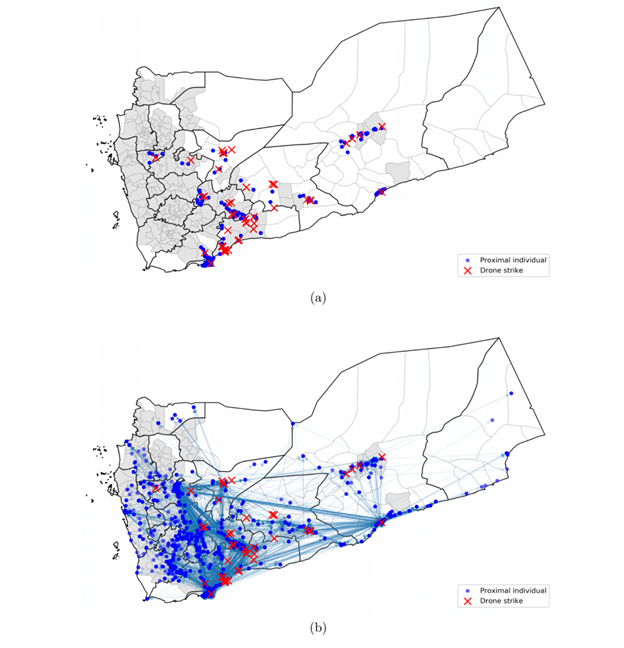
Information about drone strikes moves even farther and faster than people. Within the first hour after a drone strike, call volumes double within 15 miles of ground zero. The effect then cascades outward across social networks, causing significant increases in call volume up to three degrees of separation from strike-exposed civilians, ultimately reaching tens of thousands who never saw the strike or heard the explosion.
Why are Drones so Disruptive?
Why are drone strikes so much more disruptive than their precise targeting and small payloads would suggest? The most compelling explanation is “anticipatory fear”—anxiety specific to an unseen weapon that can return without warning. For civilians, this type of anxiety and uncertainty about the future is a key trigger for displacement.
Another possibility is that drone strikes have developed a negative reputation specific to the platform and strike type. Civilians living under drone campaigns in Yemen and Pakistan have long been aware of drones as distinct from other airstrikes. Pakistani civilians’ perception of drones’ reputation, for instance, is a powerful determinant of their attitudes about counterterrorism even if they are factually misinformed by militant propaganda.
Both mechanisms help explain why drones caused so much displacement and why information about strikes cascaded rapidly across the social networks of people who were exposed, spreading potentially disruptive information far beyond the geographic area targeted. This raises a worrying possibility: information about strikes spread far and quickly (approximately 85,000 people in our data are “exposed” to at least one strike, and a further 84,000 receive a call from a strike-exposed person within 80 minutes after a drone strike), possibly creating widespread and hard to reverse negative impressions.
The Strategic Costs of Non-Lethal Disruption
The non-lethal effects of drone strikes have substantial humanitarian and political costs. On the humanitarian side, research shows that violence-induced displacement has severe negative consequences for mental and physical health of displaced persons, and for the economic fortunes of the displaced and the communities they leave.
Strikes likely also create political costs, according to a body of previous research linking air campaigns to civilian grievance. Drone strikes may fuel Yemenis’ overwhelmingly negative attitudes about U.S. counterinsurgency, which persisted even through periods in the Obama administration when the rate of civilian casualties from drone strikes decreased due to stricter rules of engagement.
In the most recent public opinion poll in Yemen by ArabBarometer in 2018, an overwhelming 93% of Yemenis said that U.S. foreign policy was bad for Yemen, and 84% said that terrorist attacks against the United States were a “logical consequence” of U.S. actions in the Arabian Peninsula. There were 36 confirmed U.S. drone strikes in Yemen in that year alone.
U.S. strikes could have generated grievances even when no civilians died. Decades of research has emphasized the importance of civilian attitudes in asymmetric conflicts, but has often pointed to minimizing civilian casualties as a solution. This clearly matters, but our research raises the possibility that for at least some types of violence, non-lethal disruption can have negative effects as well.
Non-Lethal Disruption Should Be Weighed as a “Cost” of Strikes
In the 16 years since the U.S. armed drone campaign began in earnest, watchdogs have documented some 1,400 strikes in Pakistan, Libya, Somalia, and Yemen alone. The tempo of strikes is not clearly slowing. In 2026 alone—leaving aside the large role played by U.S. drones in the conflict with Iran—the U.S. has acknowledged 46 drone or air strikes in Somalia (on pace for the highest annual total ever) and been linked to an ongoing campaign of strikes against the Houthis in Yemen resulting in the loss of as many as 16 drones over the last 12 months.
Though the effects of drones might vary across countries and over time, evidence from other theaters like Pakistan and Ukraine suggests that the psychological effects of drone strikes have changed little in the past 15 years. We therefore expect that our findings—drawn from Yemen in 2010-2012, early in the era of armed drones—remain relevant to understanding the effects of counterterrorism strikes today.
The strategic case for drone campaigns has always rested on a cost-benefit analysis that counts militant (and civilian) casualties, but omits civilian displacement or attitudinal changes. Our findings suggest that the omission has been substantial: strikes disrupt civilians’ lives, cause displacement, spread fear and uncertainty across social networks in Yemen, and create substantial strategic costs that have never appeared on the ledger.
Our empirical analysis cannot determine whether the U.S. drone campaign achieved its strategic objectives in Yemen. However, after hundreds of drone strikes, al-Qaeda and other militant groups continue to operate there, while Yemenis grew strongly opposed to continued U.S. airstrikes. Our micro-level findings, though, are consistent with tactics driving strategy, or what strategist B.A. Friedman calls the ends-ways-means fallacy: the mistaken assumption that repeated tactical successes aggregate into positive strategic effects. In Yemen, this assumption may be worse than mistaken. The tactical successes of the drone campaign generate strategic costs.
The clear implication is that planners need to minimize civilians’ exposure to strikes, beyond keeping them out of the blast radius of the warhead. If this cannot be accomplished—especially given that adversaries have strong incentives to embed in populated areas precisely to make targeting discrimination harder—then the strategic costs of using drones for counterterrorism, especially against low and mid-level targets, might consistently exceed the tactical gains from successful strikes.
Aidan Milliff is an Assistant Professor of Political Science at Florida State University. His research focuses on how people interpret and respond to political violence, with additional focus on the politics of South Asia, forced migration, and political psychology. He earned his PhD in Political Science from MIT.
Paolo Bertolotti is a researcher focused on inference and diffusion in complex networks. He holds a PhD is Social & Engineering Systems and Statistics from MIT, where his research was supported by a National Defense Science and Engineering Graduate (NDSEG) Fellowship.
Ali Jadbabaie is the JR East Professor of Engineering and the head of the department of Civil and Environmental Engineering at MIT and a core faculty member of the Institute for Data, Systems, and Society. His research is on decision theory, optimization and control theory, network science, and computational social science.
Fotini Christia is the Ford International Professor of the Social Sciences at MIT. She is Director of the Institute for Data, Systems, and Society, and Academic Chair of the doctoral program in Social and Engineering Systems at MIT’s School of Engineering and Schwarzman College of Computing. Her research bridges data science and computation, by examining how to effectively integrate computational and AI tools in complex sociotechnical problems.
Main image is U.S. Air Force MQ-9 Reaper assigned to the 556th Test and Evaluation Squadron on the ramp at Creech Air Force Base, Nevada, Sept. 3, 2020, taken from DVIDS.
The views expressed are those of the author and do not reflect the official position of the Irregular Warfare Initiative, Princeton University’s Empirical Studies of Conflict Project, the Modern War Institute at West Point, Department of the Army, Department of War, or the United States Government.
If you value reading the Irregular Warfare Initiative, please consider supporting our work. And for the best gear, check out the IWI store for mugs, coasters, apparel, and other items.