For the upcoming Holiday Season – and just in time for Black Friday – the staff of IWI’s Maritime Program, along with select authors and experts – are providing the following reading recommendations as gift ideas. Our team is highlighting texts that they find to hold valuable insights on maritime themes, irregular warfare, or economic, cultural, or technological developments that impact the global commons and may impact future conflict. In our section, “Santa’s List,” we provide a list of some of our favorite charities for our readers’ consideration as alternative gifts.
Co-Director Maritime Program: Christopher Booth – Book Recommendations:
David Kilcullen, Out of the Mountains: The Coming Age of the Global Guerilla, (Oxford University Press, 2013).
Despite being more than a decade old, Kilcullen’s thesis that conflict will increasingly focus on “crowded, coastal, and connected cities,” helps crystalize a frame of reference for many of the megatrends he identifies as shaping modern global society: population growth, urbanization, coastal settlement, and connectedness. In particular, he demonstrates the dangers posed by urban “feral” megacities that have grown through state failure. The recently concluded war in Gaza, continued threat posed by the Houthis to maritime trade in the Red Sea, disintegration of state power in Nigeria particularly in the Niger Delta, and festering problem of Somalia, all illustrate this book’s powerful argument.
Ronen Bergman, Rise and Kill First: The Secret History of Israel’s Targeted Assassinations, (Random House Publishing Group, 2018).
Ronen Bergman is an Israeli author with exceptional connections to those in Israel’s military and intelligence communities. The thousands of interviews he conducted on and off the record, and access he had to classified documents help ensure that this doorstop of a book (784 pages) will serve as the definitive work on the successes and failures of Israel’s efforts to kill their way out of a political problem since before the nation’s founding. The very repetitiveness of the operations (and the military/intelligence failure of October 7th), help demonstrate that “mowing the grass” by periodically assassinating terrorists and other adversaries is no substitute for a coherent political solution, and that even successes may result in unanticipated blowback that may take decades to manifest.
In the same vein, the Israeli documentary “The Gatekeepers” (2012), by Droh Moreh, in which he interviews the then six living directors of the Israeli Security Agency (ISA) (known as Shin Bet, or Shabak in Hebrew) remains a master-class and must viewing for not only understanding the Israeli-Palestinian conflict, but also the degree to which counter-terrorism efforts are not by themselves a panacea.
Timothy Snyder, Bloodlands: Europe Between Hitler and Stalin, (Basic Books, 2010).
Over 500 pages Snyder immerses readers in horrific accounts of the mass death of more than 14 million non-combatants between 1933-1945 as state policy of the Stalinist Soviet Union and Nazi Germany, throughout the killing fields of the region he categorizes as Europe’s “bloodlands” made up by a region that encompasses Poland, Ukraine, the Baltics, Belarus, and portions of Romania and Western Russia. The multilingual author had access to the archives thorough-out the region where he worked with primary sources in their original languages, and synthesized his research in a groundbreaking work. Absent an understanding of the tangled histories of the people of the region who were frequently both victims and willing perpetrators of pogroms, ethnic cleansings, forced migration and other horrors one is unprepared to fully understand the histories and viewpoints that influence Eastern Europeans, Balts, and especially Ukrainians as they fight yet again their historic enemy.
Santa List:
St. Javelin – What started as a meme has now raised millions of dollars for a variety of Ukrainian charities and NGOs. Its impact has ranged from a multi-story painting of the ubiquitous Orthodox Madona holding a javelin anti-tank rocket; to supporting a Ukrainian clothing industry; and donating fleece tops to children who have lost parents in the war, socks and other gear to the Ukrainian troops along the FLOT. Buy their ever-popular Ukrainian war themed ugly Christmas sweaters, or something for anyone on your list knowing that not only are you able to demonstrate your support through stickers or clothing, but you are helping contribute directly to troops and programs in Ukraine.
United24 – The Initiative of the President of Ukraine, is the official fundraising platform of Ukraine. The largest charity for Ukraine has charitable ambassadors ranging from Luke Skywalker himself – Mark Hamill, and Oscar-winner Hillary Swank, to the band Imagine Dragons, and country star Brad Paisley. Bear Grylls and Scott Kelly – the astronaut, offer support from the adventure set, and Oleksandr Usyk – the world unified heavyweight champion is one of many athletes supporting their wide-ranging work. One of the most immediately impactful opportunities is provided by downloading the U24 app, which allows you to contribute to specific Ukrainian drone units directly.
NOR DOG Frontline Animal Rescue in Ukraine. On the microlevel Norwegian entrepreneur Frederik Guttormsen and his small team rescue dogs whose owners have had to abandon them as the flee advancing Russian troops – primarily in Kharkiv – and reunite them with their families. Leveraging Guttormsen’s business background they also produce dog-food and distribute 20-40,000kg of food per month. They actively post on Instagram with updates on their rescues. Their work was featured in the New York Times.
Galgos del Sol helps rescue Spanish greyhounds. In the words of the charity, “Galgos are widely used by hunters in the rural areas of Spain for both hunting and hare coursing with betting. They are considered disposable and when the short hunting season ends each year, tens of thousands are abandoned or brutally killed by their owners to whom they are no longer of use.” On an almost daily basis GDS rescues galgos and podencos abandoned on the streets, many of which have been abused, abandoned, hit by cars, or horrifically tortured. I’ve personally volunteered at the rescue, and it is amazing the work they do caring for 200+ dogs and seeking out new homes. They also post daily on Instagram with updates.
Co-Director Maritime Program: Walker Mills – Book Recommendations:
Toshi Yoshihara, Mao’s Army Goes to Sea: The Island Campaigns and the Founding of China’s Navy, (Washington, D.C: Georgetown University Press, 2023)
Dr. Yoshihara has done a great service to practitioners, policy makers and academics alike in his relatively brief, and accessible account of the People’s Liberation Army’s amphibious campaigns The history draws on new primary sources, and is a must-read for anyone interested in how to build professional amphibious forces from scratch, but the history is most interesting when the readers remembers that these campaigns form the core of experience and narrative of the People’s Liberation Army Navy. As I wrote in a review for Naval History, the only drawback is that Dr. Yoshihara “leaves the reader wanting more.”
Milan Vego, Maritime Strategy and Sea Denial: Theory and Practice, (New York: Routledge, 2019)
US Naval War College professor Milan Vego is a national treasure, and continues to publish books that should be required reading for anyone interested in naval strategy or operations (his latest is (Exercising Control of the Sea: Theory and Practice, 2022). I have referenced and reread his 2003, Naval Strategy and Operations in Narrow Seas more times than I can count. I have come back to revisit Maritime Strategy and Sea Denial, because it explicitly focuses on weaker powers at sea – outlining a strategic framework for that perspective, and in his typical style Vego draws on hundreds of years of maritime history to make his points – much of which readers may be learning for the first time.
Joshua Tallis, The War for Muddy Waters: Pirates, Terrorists, Traffickers and Maritime Insecurity, (Annapolis, MD: Naval Institute Press, 2019)
I have also been revisiting The War for Muddy Waters, by Dr. Joshua Tallis, from the Center for Naval Analyses. This heavily researched book outlines a framework for understanding the Navy’s role in the littoral – and breaks out the overlapping circles of national security, human security and economic development in the term “maritime security.” Now, the second part, “Cocaine and Context in the Caribbean” is particularly relevant as the US Navy is taking a larger counter-narcotics and counter-trafficking role in the Caribbean.
Santa List:
Navy and Marine Corps Relief Society
The Navy and Marine Corps Relief Society (NMCRS) is one of the best organizations that directly aids active-duty Marines and sailors in need. Anyone who has served in the sea services has a chest full of stories about service members and families who have been helped by the NMCRS.
Founder and Director Emeritus IWI Maritime Program: Lisa Munde – Book Recommendations:
Ian Urbina, The Outlaw Ocean: Journeys Across the Last Untamed Frontier, (Vintage, 2020).
Urbina blends storytelling and investigative journalism to expose the challenges of governance and enforcement across the world’s ungoverned oceans. A former New York Times reporter and Pulitzer prize-winning journalist, he documents how overlapping jurisdictions, weak governance, and flag-of-convenience loopholes enable forced labor, trafficking, illegal resource extraction and environmental crimes. The book vividly illustrates the dichotomies that define the maritime domain—where global commerce, human exploitation, and environmental degradation coexist in the same unregulated space. What stands out in this book are both the compelling topics covered in the book and Urbina’s excellent writing that make it a page-turner and a joy to read. (
Edward Fishman, Chokepoints: American Power in the Age of Economic Warfare, (Portfolio, 2025).
Chokepoints offers a timely and authoritative framework for understanding how economic statecraft and maritime geography intersect. Fishman, a former U.S. State Department sanctions architect, examines how the United States wields influence through control of strategic chokepoints—ranging from physical chokepoints like shipping lanes and maritime straits to global financial networks such as SWIFT. The book also contextualizes the historical role of naval forces in underpinning a nation’s ability to enforce sanctions through blockade and embargo.
Admiral James Stavridis, USN (Ret.), Sea Power: The History and Geopolitics of the World’s Oceans, (Penguin Books, 2017).
This is the quintessential primer on the role of sea power in history and geopolitics. Stavridis provides a comprehensive tour of the world’s oceans, explaining how each body of water—the Atlantic, Pacific, Indian, Arctic, and Mediterranean—has shaped global trade, security, and influence. Drawing on both scholarly historical analysis and firsthand practitioner experience, he shows how maritime geography underpins strategy, coalition building, commerce and the global order.
Rose George, Ninety Percent of Everything: Inside Shipping, the Invisible Industry That Puts Clothes on Your Back, Gas in Your Car, and Food on Your Plate, (Metropolitan Books, 2013)
In a brilliantly written account, George embeds aboard Maersk Kendal on a voyage from Europe to Asia to examine the global shipping industry that transports nearly 90 percent of world trade. The book confronts “sea blindness” by revealing how a system essential to global commerce operates mostly out of sight and beyond public understanding. She documents challenges of modern container logistics including the long and isolating contracts endured by seafarers, the operational and legal complexities of flag states, and security challenges like piracy and stowaways offering a clear account of how disruptions in this largely invisible system can reverberate across global supply chains and economies.
Daniel Immerwahr, How to Hide an Empire: A History of the Greater United States, (Farrar, Straus and Giroux, 2019).
Immerwahr reinterprets U.S. history and success in the 20th century through the geography of its territories, bases, and maritime logistics networks. While not a specifically maritime-themed book, it provides a unique angle in tracing how American influence expanded through overseas infrastructure, shipping routes, and supply chains rather than formal colonial annexation. By connecting the geography of U.S. power projection—from Guam to Guantánamo—he reveals how the United States built a global presence embedded in maritime systems and why maritime superiority remains important in the modern era.
Maritime Program Fellow: Brian Kerg – Book Recommendations:
Hsiao-ting Lin, Taiwan, the United States, and the Hidden History of the Cold War in Asia: Divided Allies, (New York: Routledge, 2022)
While this book is largely focused on the challenges faced by the alliance between the United States and Taiwan during the Cold War, it uses a host of recently unclassified Taiwanese and American sources to depart from previous scholarship in many important ways. Irregular warfare abounds, including clandestine cross-strait operations conducted by Taiwanese forces against the People’s Liberation Army, secret military support of the Nationalists for guerrilla movements in Asia aimed at disrupting Chinese Communist Party expansion, and Taiwan’s significant role as a base for U.S. operations in Vietnam. This newly uncovered history will cause many readers to reevaluate their assessment of the strategic value of Taiwan to any ally, in both the past and the future.
John Curatola, Armies Afloat: How the Development of Amphibious Operations in Europe Helped Win World War II, (Lawrence, Kansas: University of Kansas Press, 2025).
Often lost in the grand telling of World War II’s amphibious operations is the story of how the Allies learned to conduct them. Using the warfighting framework called for in U.S. amphibious doctrine of the time, this book explores the development and capabilities of Allied amphibious operations in the Mediterranean and European theaters of operation. It introduces readers to a cast of unsung heroes who were essential to the development of U.S. amphibious capabilities, and highlights the many developmental contributions of commanders better known for their leadership in combat.
Brian Christian, The Alignment Problem: Machine Learning and Human Values, (New York: W.W. Norton & Company, 2020).
The constant hype surrounding the promise of artificial intelligence often overshadows its risks, and what risk is presented can often be dismissed as irrational fear inspired by dystopian science fiction. Here, the author clearly and convincingly describes the very real challenges of aligning artificial intelligence with human values. IWI readers will immediately make connections between these risks and the implications for conflict, information warfare, and psychological operations conducted both abroad and domestically.
Santa List:
Sea Shepherd is an international, non-profit marine conservation organization that engages in direct action campaigns to defend wildlife, and conserve and protect the world’s ocean from illegal exploitation and environmental destruction.
Maritime Program Fellow: Pieter Zhao – Book Recommendations:
Benjamin Armstrong, Small Boats and Daring Men: Maritime Raiding, Irregular Warfare, and the Early American Navy, (University of Oklahoma Press, 2019).
This book explores the largely overlooked role of irregular maritime operations in the early American Navy, focusing on coastal raiding, small unit tactics, and operations outside the traditional line-of-battle or commerce-raiding frameworks. While the concept of “maritime irregular warfare” is often viewed as a modern development, Armstrong illustrates that such practices have deep historical roots. His work, therefore, invites a reconsideration of naval history not just as a story of fleets and decisive engagements, but as one equally shaped by asymmetry, improvisation, and contested littorals. A useful starting point for thinking historically about contemporary irregular maritime challenges.
Benjamin de Carvalho and Halvard Leira, The Sea and International Relations, (Manchester University Press, 2022).
This book makes a compelling case for placing the maritime domain at the center of international relations theory and analysis. Despite the sea’s central role in shaping trade, power projection, and global order, it remains curiously underexplored in much of mainstream IR scholarship, a gap often described as sea-blindness. De Carvalho and Leira bring together a range of interdisciplinary perspectives to challenge this neglect, offering new ways of thinking about maritime space, mobility, and the global commons. While not focused on irregular warfare specifically, the volume is useful for understanding the broader context in which future maritime conflict may unfold. As non-traditional threats increasingly play out at sea, through competition over resources, infrastructure, and influence, this book provides a valuable framework for recognizing how the maritime domain continues to shape strategic behavior and global politics.
Erik de Lange, Menacing Tides: Security, Piracy and Empire in the Nineteenth-Century Mediterranean, (Cambridge University Press, 2024).
This book offers an insightful look at how irregular maritime threats like piracy shaped security and power dynamics in the nineteenth-century Mediterranean. De Lange explores how Barbary piracy (or privateering, if you will) influenced imperial strategies and contributed to the formation of global order during a critical period of transition. While focused on a historical context, the book bridges important themes from the earlier volumes by showing how non-traditional maritime threats have long affected states’ approaches to security, governance, and control of the global commons. The subject remains relevant today, not least because the United States’ own history with Barbary piracy reflects enduring challenges in managing irregular maritime threats. This is a thought-provoking read for anyone interested in how maritime irregular warfare has historically intersected with broader questions of power and global order.
IWI alum, Commander 3rd Marine Raider Battalion – LTC Paul Bailey – Book Recommendations:
As in the past, the United States faces strategic competition and potential conflict with other global powers, namely Russian and China. This competition and looming conflict have caused the United States and its military to refocus on regenerating maritime capabilities to fight both irregular and conventional wars. Against China in the Western Pacific, the United States faces immense challenges given vast time and space challenges within China’s inner sphere of influence and control especially inside the South China Sea. As the U.S. military develops maritime options, the past offers useful lessons to prepare for the future. The oft-overlooked irregular wars with the Barbary Pirates in the early 1800’s offers potentially useful lessons to the United States for both conventional and irregular warfare when faced with relative disadvantages. Especially for U.S special operations forces, early audacious raids on the captured U.S.S. Philadelphia and the unconventional warfare operation against Derna offer two of the nation’s earliest success overseas to consider for modern application against daunting challenges and odds. Here are two accounts of this noteworthy period of history to consider over this holiday season.
Josph Wheelan, Jefferson’s War: America’s First War on Terror, 1801-1805,(Public Affairs, 2003).
Two centuries ago, without congressional or public debate, a president who is thought of today as peaceable, Thomas Jefferson, launched America’s first war on foreign soil, a war against terror. The enemy was Muslim; the war was waged unconventionally, with commandos, native troops, and encrypted intelligence, and launched from foreign bases. For nearly 200 years, the Barbary pirates had haunted the Mediterranean, enslaving tens of thousands of Europeans and extorting millions of dollars from their countries in a mercenary holy war against Christendom. Sailing in sleek corsairs built for speed and plunder, the Barbary pirates attacked European and American merchant shipping with impunity, triumphing as much by terror as force of arms.
Brian Kilmeade and Don Yaeger, Thomas Jefferson and the Tripoli Pirates: The Forgotten War That Changed American History, (Sentinel, 2015).
When Thomas Jefferson became president in 1801, America was deeply in debt, with its economy and dignity under attack. Pirates from North Africa’s Barbary Coast routinely captured American merchant ships and held the sailors as slaves, demanding ransom and tribute payments far beyond what the new country could afford. For fifteen years, America had tried to work with the four Muslim powers (Tripoli, Tunis, Algiers, and Morocco) driving the piracy, but negotiation proved impossible. Realizing it was time to stand up to the intimidation, Jefferson decided to move beyond diplomacy. He sent the U.S. Navy and Marines to blockade Tripoli—launching the Barbary Wars and beginning America’s journey toward future superpower status.
Santa List:
Marine Raider Foundation: The Marine Raider Foundation is a 501(c)(3) non-profit organization that provides benevolent support to active duty and medically retired MARSOC Raiders and their families, as well as to the families of Raiders who have lost their lives in service to our Nation. Since standing up in May of 2012, the Marine Raider Foundation has provided over $7 million in support to MARSOC Marines, Sailors and their families. The Foundation aims to meet needs unmet by the government with an emphasis on building personal and family resiliency and supporting the full reintegration of MARSOC personnel following wounds, injuries and extended deployments.
Fisher House Foundation: Fisher House Foundation builds comfort homes where military & veteran families can stay free of charge, while a loved one is in the hospital. Since inception, the program has saved military and veterans’ families an estimated $650 million in out-of-pocket costs for lodging and transportation.
IWI author: Dr. Ian Ralby – Book Recommendations:
James Clavell, Tai-Pan: The Epic Novel of the Founding of Hong Kong, (Atheneum, 1966).
This historical fiction (with a lot of historical accuracy) tells the story of the founding of Hong Kong by the British and American opium traders following the British victory in the First Opium War. This era of Chinese history is both fascinating and vitally important to understanding some of the drivers behind China’s behavior today.
Max Hardberger, Seized! A Sea Captain’s Adventures Battling Pirates and Recovering Stolen Ships in the World’s Most Troubled Waters, (Nicholas Brealey Publishing, 2010).
The maritime industry is out of sight and out of mind for most people, even, sometimes, for navy sailors. The various commercial oddities of an inherently international industry with centuries of rules and traditions can even be hard to believe. This true story of the work of a maritime repo man is beyond compelling and opens anyone’s eyes to a world that few even know exists.
David Grann, The Wager: A Tale of Shipwreck, Mutiny and Murder, (Doubleday, 2023)
This true story of a British vessel sent on a secret mission to pursue a Spanish prize vessel in 1740 involves murder, mutiny, a shipwreck and a court martial. The story is absolutely riveting, and made all the more so knowing that one of the key characters in the story – a young midshipman – is the future Admiral John Byron, grandfather of the poet Lord George Gordon Byron. Indeed, the Admiral’s account of the scandalous voyage provided the inspiration for Lord Byron’s epic poem, Don Juan.
IWI author: Ben Connable – Book Recommendations:
Harry Allanson Ellsworth, One Hundred Eighty Landings of the United States Marines, 1800-1934, (Washington, D.C., Headquarters, U.S. Marine Corps History Division, 1974).
In a sometimes-frustrating old-school style, Ellsworth sets the context for lots of amphibious landings most Marines are not even vaguely aware of. His definition of “amphibious landing” is far too loose; it should not include going ashore to render burial honors in France, etc. But this volume includes lots of examples of young lieutenants, captains, and NCOs being thrust ship-to-shore into complex and uncertain situations including urban rioting, riverine search, seizure, and fighting, naval combat with coastal fortifications, civil war, and full-scale combat against defending forces. Readers will get a good sense of the range of things Marines have done and can do from the sea. Think routine embassy reinforcements and noncombatant evacuation operations with some gunfighting. Who has ever heard of the Battle of Barranca? How about BG John Russell, USMC, being appointed temporary Ambassador Extraordinary to Haiti? Marine Guard raiding parties into Nicaragua to blow up rebel supplies? Read on, skim as needed.
Nicholas J. Schlosser, U.S. Marines and Irregular Warfare Training and Education, 2000-2010, (Quantico, Vir.: United States Marine Corps History Division, 2015).
To paraphrase George Santayana, only the dead have seen the end of irregular war. We’re fighting several irregular wars now in Iraq, Syria, the Philippines, and elsewhere, and we will almost assuredly be dragged into another larger-scale conflict in the coming years. Keep in mind that nobody in the United States expected our nation would be sending troops into Nicaragua, Haiti, or the Dominican Republic in the first part of the 20th Century, or Vietnam, Lebanon, or the Balkans in the last half of the century. Nobody predicted a counterinsurgency fight in Iraq, a long-running counterterror-COIN fight in Syria, or the 20-year irregular war in Afghanistan. “By the pricking of my thumbs, something wicked this way comes,” and we are not ready for it. What can you do as a professional? Start reading about IW now and think about how we are going to stand back up, yet again, the infrastructure we need to succeed or at least not allow our government to punt another war into the f***ing stands.
Gary D. Solis, Marines and Military Law in Vietnam: Trial By Fire, (Washington, D.C.: History and Museums Division, Headquarters, U.S. Marine Corps, 1989).
This may seem like an unusual pick, but I think it may be more relevant than any other recommendation in this list. What is a war crime? What constitutes legal behavior in war? Why is it important to the United States that our servicepeople behave honorably and legally, and particularly so when living in other cultures in the context of an irregular war? This monograph covers regular crimes, criminal justice, and war crimes in an irregular context. As any veteran of Vietnam, Afghanistan, or Iraq will tell you, irregular war requires extraordinary adaptability, intellectual focus, and integrity. Take a look at the repercussions from the Abu Ghraib incident. I met many insurgents who stated clearly that they chose to kill Americans because of the way Iraqi prisoners were abused at Abu Ghraib. Yes, we have to be lethal, but we have to be legal as well, both for our own moral virtues and for the sake of military success.
Santa List:
Patrol Base Abbate (PBA) was established by Marine LtCol Tom Schueman in honor of Sergeant Matt Abbate. With events restricted by cost and availability, the PBA team brings any honorably discharged veteran from any service out to Montana to engage with other servicepeople in an exhilarating fresh-air environment, to lead and participate in lots of activities like fishing, hiking, and golf, and to reconnect and reset. This program is specifically intended to help address the epidemic of suicide amongst Iraq and Afghanistan veterans, but there are no age limits and no combat experience is needed to be included in what PBA refers to as a “Return to Base,” or RtB. SOF bros welcome but have no head-of-line privileges.
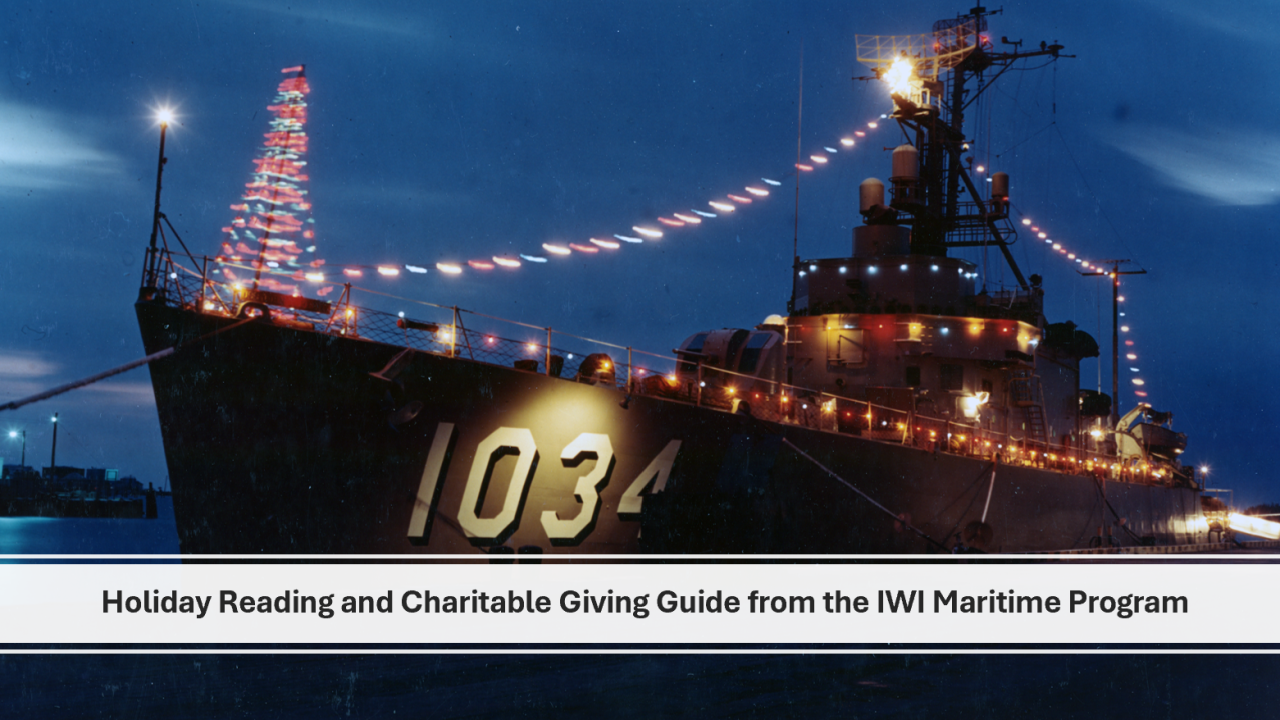
Main Image: Christmas lighting aboard ship while at Key West Naval Station Annex, Key West, Florida. The winner for Destroyer Division 601, 25 December 1961. Courtesy of Naval History and Heritage Command.
Please note that this list is for informational purposes only. We do not endorse the specific work, warrant the current 501(c)(3) status, or accept any liability for the actions or financial performance of these independent third-party organizations, and we strongly encourage all donors to conduct their own due diligence.
The views expressed here are those of the author and do not represent the positions or opinions of the US Marine Corps, the Department of Defense, or any part of the US government.
If you value reading the Irregular Warfare Initiative, please consider supporting our work. And for the best gear, check out the IWI store for mugs, coasters, apparel, and other items.


Leave a Reply