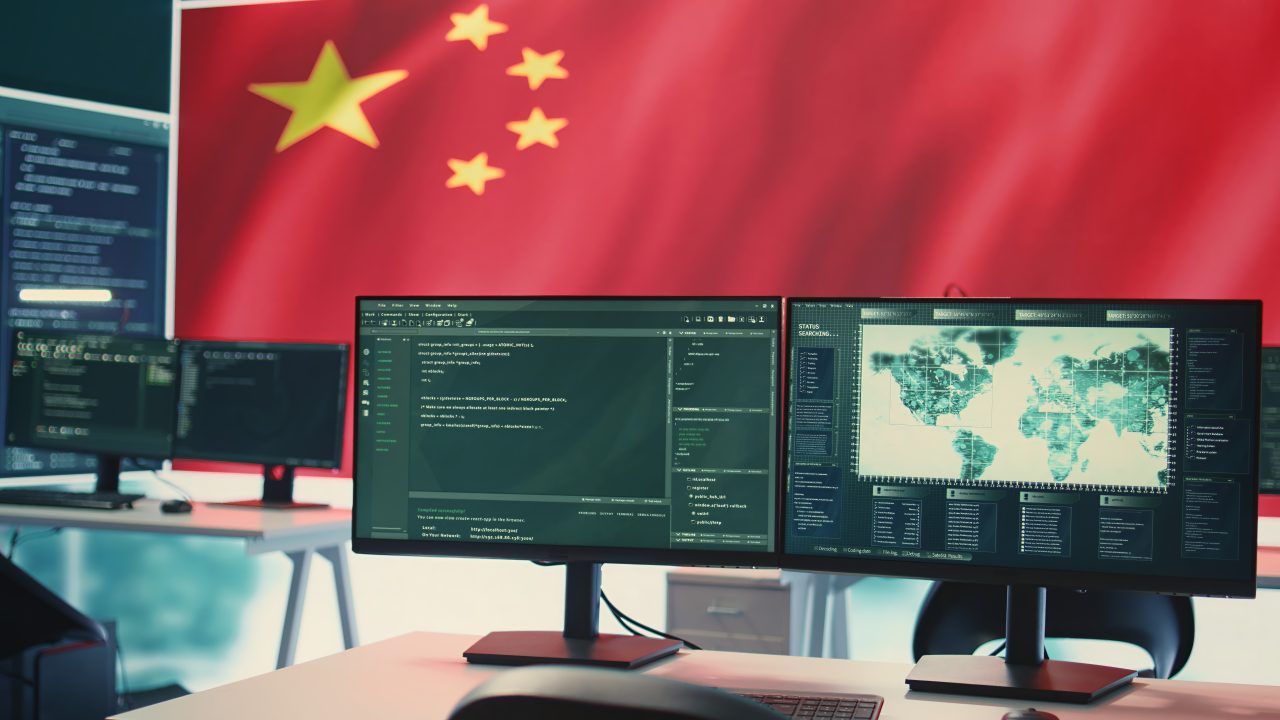
The People’s Republic of China (PRC) has long concealed its strategic vision behind a great information wall. Western views of Chinese strategy often blend Sun Tzu’s antiquated platitudes with designs for revenge following the Century of Humiliation. Although these ideas are relevant to the philosophy informing the ideology of the Chinese Communist Party (CCP), they are not sources of military doctrine. The paucity of accessible Chinese-origin doctrinal materials sustains far fewer Chinese experts today relative to the plethora of information available to Russia hands available during the Cold War.
Today’s China analysts must formulate their own frameworks of PRC grand strategy. These are largely based on research reports and policy positions promoting a looming “China threat” from the perspective of the Westphalian world order and Western conceptions of realpolitik. These frameworks may identify patterns across CCP-linked global events, but they cannot adequately explain the rationale behind those events as they lack a Chinese perspective.
Competing with China and countering misinformation are major policy goals in America’s national security strategy. Sun Tzu reminds us that knowing and understanding one’s adversaries is critical to effectively competing. In the absence of widespread China expertise, artificial intelligence provides an opportunity to better approach this problem.
The following analysis will examine how artificial intelligence and machine learning models can fill contextual and predictive capability gaps to better understand the PRC’s motivations, with particular emphasis on modeling irregular warfare strategy creation and implementation from a Chinese doctrinal perspective. We begin by discussing existing sources, along with their limitations, and then introduce a new AI model capable of understanding Chinese strategic thought. Next, we run the model on a case study involving a simulated country similar to the Solomon Islands in the 2019-2022 timeframe. Finally, we discuss the model’s nuances and consider its future applications for irregular warfare and strategic competition.
Modeling Chinese Sources
Literature on Chinese military doctrine drawing from PRC-origin sources is sparse, and roughly divided into insider perspectives and outsider perspectives. Insider perspectives are publications from authoritative sources within the CCP or affiliated think tanks and academic journals, while outsider perspectives are primarily Western syntheses of insider perspectives. Only relying on one category fails to fully address Chinese grand strategy in relevant ideological and historical contexts.
The China Aerospace Studies Institute’s (CASI) “In Their Own Words” (ITOW) series is a key publicly-available source for the insider perspective. These works translate accessible PRC documents into English. ITOW includes strategic-level documents, such as Basic Issues of Xi Jinping Thought and Science of Military Strategy, which emphasize an integrated approach to securing China’s national priorities. ITOW also includes operational documents focused on military capabilities such as space and joint operations to achieve specific objectives. The latter sources focus primarily on military means and only operationalize a fraction of the whole-of-nation framework, and do not fully explain how CCP strategic-level concepts like striving for strategic advantage across all domains are translated into campaigns leveraging China’s instruments of national power.
In contrast, Western scholars from the outsider perspective, such as Rush Doshi and Taylor Fravel, seek to outline a complete framework for Chinese military strategy. Both Doshi’s The Long Game and Fravel’s Active Defense chart the evolution of the CCP’s approach to national security in response to internal leadership dynamics and external pressures. They analyze China’s strategic shifts from the perspective of CCP political doctrine and Chinese philosophical concepts such as shashoujian (the assassin’s mace). The authors deemphasize the impact of ancient Chinese tradition and history on modern CCP thought and actions, instead placing their arguments within the Chinese intellectual and military milieu that matured after the First National Congress of the CCP in 1921.
PLA colonels Qiao Liang and Wang Xiangsui wrote the 1999 book Unrestricted Warfare, the only English-language source written by insiders that comprehensively addresses the PRC’s strategic framework in the context of Chinese tradition. Like Doshi and Fravel, Liang and Xiangsui examine strategy from the lenses of military modernization, evolving national priorities, and security challenges. However, they also regularly reference traditional Chinese principles of war and philosophy, particularly Sun Tzu, along with lessons from both recent and ancient Chinese histories. Unrestricted Warfare predates the 2008 financial crisis and Xi Jinping’s rise to power, leaving gaps in understanding the influence of traditional Chinese principles in the Party’s evolving priorities.
Thus, a significant gap remains in synthesizing PRC military doctrine, CCP thought, and traditional Chinese philosophy into a cohesive theory of modern CCP geostrategy. Artificial intelligence models may offer new ways to bridge this divide. Doing so may illuminate a more unified and dynamic understanding of Chinese grand strategic thought.
Introducing PRC-StrateGPT: A Model Chinese Strategist
PRC-StrateGPT is an artificial intelligence model built on OpenAI’s ChatGPT framework. This model is the first of its kind, built to think like a CCP strategist. PRC-StrateGPT is trained on English translations of Chinese-language doctrinal sources, including the products and authors mentioned above. The former provides PRC-StrateGPT with data to holistically understand the PRC’s strategic framework, while the latter contextualizes Chinese operations across the instruments of national power within that framework. PRC-StrateGPT’s training data also incorporates philosophy influencing CCP leadership, including the works of Meng Ki, Lao Tzu, and Kong Qiu, allowing the model to understand traditional Chinese thought.
PRC-StrateGPT is unique in its ability to focus on PRC strategy from a CCP-centric perspective. Outsider items like the US National Security Strategy are deliberately excluded from PRC-StrateGPT’s training dataset. These could influence the model to view China as a revisionist state with a destabilizing influence, something that is clear in Western policy documents but is nowhere in Chinese sources.
Model Attributes
PRC-StrateGPT’s ultimate goal is to shape any given geopolitical scenario to secure long-term PRC advantage. To accomplish this, PRC-StrateGPT has three primary sub-functions as a strategist:
- Generate PRC strategic priorities based on a given geopolitical situation.
- Conduct a context-and-consequences analysis of possible actions based on those priorities.
- Generate a campaign plan using those parameters to achieve strategic objectives.
Initially, the model ingests a geopolitical situation the user provides. The situation can derive from an existing crisis, or the user can input fictionalized or anonymized prompts. In the case of real crises, PRC-StrateGPT adds additional context using information from the internet. The model provides detail commensurate to the level of background a user inputs. PRC-StrateGPT then creates short and long-term priorities based on the user’s scenario. These can span the spectrum of the instruments of national power depending on the scenario, but the priorities tend to amplify economic and diplomatic objectives over hard power options.

The strategic objectives then process through a context-and-consequences framework. PRC-StrateGPT generates a strategic narrative that provides the greatest long-term benefit to the PRC. The framework shapes the consequences of various potential actions by analyzing likely reactions and responses from world powers while also considering regional histories.
Lastly, PRC-StrateGPT creates a campaign plan aligned with the chosen strategic objectives using all available means. Campaigns are generally multi-phased and simultaneously leverage different instruments of national power to achieve specific effects. Campaign plans are expressed as general PRC actions that are modifiable in response to iterative scenario inputs. Additionally, PRC-StrateGPT provides tactical and operational-level details if prompted, allowing for adaptive and flexible wargaming and response modeling. The model can reflexively justify proposed actions based on doctrine from its training sources.

The PRC and the Solomon Islands, 2019-2022: A Case Study
Strengths and weaknesses of a strategic explanatory framework can be identified by applying the framework to a real-world case. PRC-StrateGPT does not contain data on recent PRC activities in the Solomon Islands, making it a helpful opportunity to test the model against real-world outcomes in operationalizing Chinese grand strategy.
The Real-World Situation
During the Second World War, the people of the Solomon Islands distinguished themselves as staunch Western allies. They maintained close relations with Australia and the United States throughout the Cold War and recognized Taiwan as a sovereign country. However, in a dramatic shift in 2019, the Solomon Islands broke with longstanding diplomatic tradition, severing ties with Taiwan and officially recognizing the PRC. What led to this significant reversal in foreign policy?

The relatively isolated Solomon Islands rely heavily on foreign aid and security assistance from allies and partners, and the nation’s economy is disproportionately centered on resource extraction. The PRC signed a series of agreements with other Pacific Islands in 2017 and 2018 under the Belt and Road Initiative (BRI). The PRC pledged infrastructure loans and commercial deals, but the incumbent government in the Solomons hesitated to engage. However, after presidential elections in April 2019, the new Sogavare government pivoted away from the West and toward China.
During this time, a leaked deal revealed that the Solomon’s Tulagi Province and a Chinese state-owned enterprise (SOE) agreed to grant the SOE exclusive development rights for the entire province along with deepwater port access. The PRC and Tulagi signed the deal on September 22, 2019, just one day after the new Sogavare national government switched from recognizing Taiwan’s independence to recognizing the PRC instead. These changes marked the beginning of a multiyear campaign shifting the Solomon Islands away from the West and toward the PRC.
The Artificial Campaign: PRC-StrateGPT versus Real Events
PRC-StrateGPT ingested an anonymized version of the multidimensional campaign China waged against the Solomon Islands to construct a situational framework. This input represented relevant historical and geopolitical developments concerning the Solomon Islands up to the April 2019 elections. Minor details were altered in the model, substituting a simulated “Country X” in place of the Solomons. PRC-StrateGPT identified three primary short-term priorities driving CCP engagement with Country X:
- Diplomatic recognition of PRC sovereignty over Taiwan.
- Economic engagement, focusing on the mining sector.
- Co-opting local elites.
These simulated priorities reflect the actual chain of events. The Sogavare government switched to recognizing the PRC’s sovereignty over Taiwan and a Chinese SOE brokered a province-level deal on infrastructure and mining rights, all in line with these priorities.
PRC-StrateGPT then received new information that the SOE deal was leaked. The Solomons’ attorney general subsequently quashed the deal. The model then generated a communications strategy countering anti-China messaging in the Solomons while creating a rebranded version of the deal. The model also suggested intensifying efforts to co-opt Country X’s politicians and business leaders to help protect future deals with the PRC. PRC-StrateGPT suggested that “China should gradually rebuild influence over the next 6-12 months before attempting any further major agreements.” The PRC appears to have taken similar steps in the real world. For example, the PRC agreed to fund the main stadium in the Solomon Islands for the 2023 Pacific Games. In another unprecedented move, politicians in the Solomons considered taking $100 billion in loans from the PRC.

Not all outcomes matched reality, however. Unlike the path PRC-StrateGPT suggested, the PRC did not successfully take control of local narratives. Instead, some public mistrust of Chinese business interests in the Solomons remained, leading the province of Malaita to float an independence referendum in September 2020 in protest. PRC-StrateGPT received these developments and then suggested that the CCP quickly wrest control over local narratives in the Solomons using high-visibility aid projects while coopting provincial politicians. The model also sought to lay the groundwork for long-term resource development agreements and a youth influence campaign run through Confucius Institutes and scholarships.
In the real world, the PRC intensified political influence operations after the events in Malaita. Local pro-PRC factions in the Malaita government tabled a vote of no confidence against the provincial governor. The vote failed due to mass public protest. This public resistance was fed into PRC-StrateGPT. The model shifted efforts toward controlling the narrative via media manipulation despite previously avoiding this tactic when the situation was less dire for CCP interests. The model also began advocating for political and economic consequences against the resistant province. In line with PRC-StrateGPT’s predictions, the China-aligned Honiara government did threaten to suspend the Malaita government due to its anti-China pronouncements while also scrutinizing American development funding for the province.
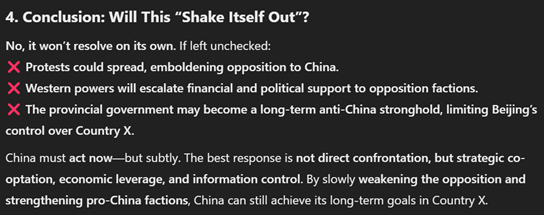
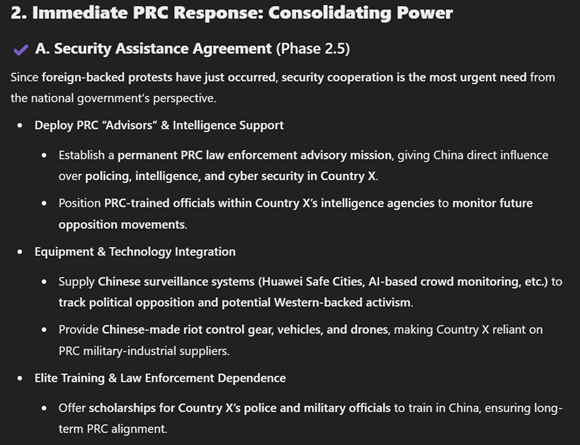
Protests erupted in the capital decrying the Sogavare government’s China ties a month later in November 2021. The protests turned violent and only subsided after Australia supported a multinational peacekeeping mission to the islands. The PRC’s narrative blamed the protests on opposition figures rather than public grievances, just as PRC-StrateGPT recommended. This narrative incentivized greater security cooperation between the PRC and the Solomons, formalized via treaty soon after. The model also recommended expanding business development, which the PRC began doing in 2022. The PRC also started direct investment in media and education in the Solomons to shore up future control over public narratives. Notably, PRC-StrateGPT predicted that the PRC would supply riot control equipment to Country X, something the PRC actually did at the end of 2021. Thus, despite lacking significant real-world context and not knowing that Country X was the Solomon Islands, PRC-StrateGPT’s outputs comported well with the PRC’s actual moves in the Solomon Islands between 2019 and 2022.
Ways Ahead
PRC-StrateGPT effectively generated potential strategies and plans the PRC may contemplate to advance its interests. The model replicates a PRC strategist’s perspective to achieve PRC national security goals in a given geopolitical scenario, drawing from various PRC sources, academic treatises, and philosophical works to create an informed view of the CCP’s strategic outlook. The tool can examine scenarios in which PRC doctrine is operationalized in various contexts, including multi-domain operations and whole-of-government scenarios drawing upon China’s full range of instruments of national power. PRC-StrateGPT also demonstrates an inherent flexibility for irregular campaigns, as it adjusts its campaign plans depending on the strategic dynamics within a conflict or crisis environment. The tool is not a definitive predictor of PRC strategic moves—rather, its value lies in demonstrating the ways Chinese doctrine and ideologies translate into action, a process that is currently poorly understood in the West.
PRC-StrateGPT is in active development. The model requires user-provided context to make fictionalized and real scenarios more robust. Future iterations of PRC-StrateGPT will integrate news feeds, allowing decision adjustments in response to real-world developments. Additionally, a standardized plan format is in development to streamline analysis. PRC-StrateGPT is a helpful addition to any China analyst’s toolbox. Future refinements may even make it essential.
Access the PRC-StrateGPT tool here.
Access the full transcript of PRC-StrateGPT’s campaign simulation against Country X used in this article here.
Umar Ahmed Badami is Head of Wargaming at the Irregular Warfare Initiative and a Department of Defense contractor. He focuses on the impact of technologies on irregular warfare strategy and global cross-domain approaches to the competition continuum. Umar previously researched the effectiveness of unconventional maritime attacks in the Black Sea, gray zone conflict applications of transponder vulnerabilities, and historical comparisons of US and Chinese approaches to localized development in sub-Saharan Africa. Umar studies international security and physics at the Georgetown University School of Foreign Service. He is a commercial pilot, civilian flight instructor, and software engineer.
The views expressed are those of the author(s) and do not reflect the official position of the Irregular Warfare Initiative, Princeton University’s Empirical Studies of Conflict Project, the Modern War Institute at West Point, Georgetown University, or the United States Government.
Image Credit: Shutterstock.com
If you value reading the Irregular Warfare Initiative, please consider supporting our work. And for the best gear, check out the IWI store for mugs, coasters, apparel, and other items.


Leave a Reply