In the ongoing conflict in Ukraine, Russia has suffered substantial setbacks. Supplies of clothing, body armor, and food are unreliable. Open-source intelligence indicates Russia has lost over 2,000 armored vehicles and hundreds of aircraft. Estimates of personnel losses are even more extensive, with one U.S. intelligence report assessing that Russia has lost nearly 90% of the troops it had at the beginning of the war. Under these conditions, one would expect low troop morale and at least some amount of criticism or discontent from the Russian public. Yet according to a survey by the independent research center Levada, Putin manages an astonishing 80% approval rating. How is this possible?
Analysts attribute Putin’s ability to limit opposition to his management of elite competition and repression of dissent. However, these explanations accentuate Putin as the protagonist and assume the Russian people have no role. A new book by Dr. Jade McGlynn, a researcher from the Department of War Studies at King’s College London, offers a different perspective by highlighting the complicity and participation of the Russian public in perpetuating the war. Russia’s War explores both Russia’s domestic information environment and, perhaps more importantly, how public opinion resonates with pro-war narratives. Rather than focus on the forms and content of Russian media, the author provides a nuanced explanation of how Russians interact with the information environment. Whereas predominant narratives center on the effects of Kremlin-generated propaganda on the Russian people, McGlynn claims that Russians are complicit in creating the narratives that justified the escalation of war. According to McGlynn, “Putin doesn’t shape Russian views on foreign policy…so much as he articulates them.” The author leverages a mixture of media analysis, survey data, and interviews to illustrate this mutually reinforcing relationship between the Russian propaganda machine and the Russian public. While the book’s technical elements might discourage a wider readership, it remains an important exploration into how a modern autocratic regime manipulates information in conventional and unconventional ways.
McGlynn situates the reader with a comprehensive description of the Russian domestic media environment and recent surge of patriotic fervor. Since February of 2021, the Kremlin has blitzed airways, workplaces, and schools with a relentless pro-war message. In turn, every level of society accommodates this new reality; pro-Kremlin news anchors are doubling their airtime, security forces crush dissident news outlets, museums now connect Ukrainian nationalism with the historical memories of Nazi Germany, and films and soap operas regularly lampoon Ukrainian characters. The Kremlin’s push to dominate the narrative has resulted in a potent mixture of spectacle, repression, and the creation of a nationalistic identity.
While the Kremlin’s propaganda tactics are well documented, Russia’s War takes its analysis a step further and asks what this information means to its audience. McGlynn rightfully acknowledges a range of attitudes among Russians, the difficulty of categorization, and the skepticism of using surveys in authoritarian countries. Nevertheless, she finds that “Russia’s war…is popular with a large number of Russians and acceptable to an even larger number.” Her findings are supported by a mixed methodology incorporating ten years of close observation of Russian state media, data analysis of some 75,000 social media posts, and 60 interviews with a mixture of elite and ordinary Russian and Ukrainian citizens. Although at times the author’s disorganized presentation of evidence can be distracting, the strength of McGlynn’s analysis is in its ability to vividly portray the perspectives of soldiers, civilians, and NGO leaders throughout the academic text. Indeed, the interview excerpts are most persuasive when she lets grandmothers, artists, and everyday workers express and explain their support for Putin.
Apathy and Repression
Although the book grants power to the storytelling abilities of media peddlers, the author details how the Russian population’s long-standing cynicism supports the war. Even before the conflict, feelings of powerlessness have been the hallmark of Russian political culture. The book cites surveys indicating widespread apathy, painting a grim picture of Russian civil activity. McGlynn notes that some 60% of the population can be categorized as politically passive. They have no capacity for action, preferring to sit at home rather than take to the streets. Even young people in Russia, usually the most optimistic across societies, have little hope for a better future. Russians are united in their indifference. In this regard, bottom-up anti-war resistance remains a non-existent force in Russian politics.
Those few who do take action elicit a strong response from the regime. In a two-week timespan immediately following the invasion, approximately 13,000 people were detained across 147 cities. Many also protested with their feet, fleeing abroad. Almost three quarters of a million Russians left in the first year of the war. Whether the average Russian is politically apathetic, scared to protest, or persuaded by the propaganda apparatus to genuinely support the war, the Kremlin has effectively crushed the threat of popular resistance, solidifying its hold on power.
A Complicit People
Despite the Kremlin’s heavy-handed approach, McGlynn does not absolve the Russian people of responsibility. The book’s central argument is that Russians themselves are complicit in the war. It is easy and sometimes more palatable to think that an all-powerful security state imposes its view of the world on a helpless population. But the author claims the relationship is mutually reinforcing. Her interviews with elite and ordinary Russians lead her to conclude that many Russians like the narrative they are being told, and the Kremlin is happy to provide it. Although the Kremlin propaganda apparatus has the budget, skill, and motivation to spin well-crafted yarns that play on feelings of resentment and aggression, Russians are also demanding stories that depict the West as threatening Russia’s peace, prosperity, and way of life. In the author’s words, “[Russian society and the Kremlin] co-create a more amenable version of the world around them.” Support for Putin and the war in Ukraine cannot only be attributed to the Kremlin’s propaganda or use of violence against dissidents. Instead, it appears that support from the Russian people is more widespread and deep-seated than the West might be willing to accept, entrenched in historical pathologies that will not easily fade.
As the war approaches its second anniversary, the question of popular support is instrumental for Russia as it struggles to break out of the current stalemate. The ability to train, equip, and – most importantly – recruit men to join the ranks will be essential to reinforcing Russian defensive positions and mounting future attacks. McGlynn does not address the question of recruitment, but her book helps us understand how the Kremlin intends to mold the information environment to mobilize support and restrain protests. Further research could investigate the effects of pro-Russian sentiment on enlistment and conscription in the Russian Armed Forces.
Russia’s War leads the reader to conclude that while the war may be fought in Ukraine, it can only end inside Russia. The root of the war lies in Russia’s societal imagination about who they are as a people and a country and therefore what role they should occupy on the world stage. As long as the country continues to profess and pursue grand ambitions beyond its capabilities, Russia’s relationship with the West will continue to be fraught. Unfortunately, this is an implication of her research that McGlynn neglects: she fails to provide a theoretical explanation of how this Russian identity developed and why it remains so stubborn to change. She also avoids examining the tension between the support Russians articulate for the war with their lack of voluntary action to support it. Her work is mostly descriptive in nature, and she could further explore what the ramifications of Russian public opinion portend for Russia’s future foreign policy. Although primarily intended for an academic audience or those with a background in Russian studies, Russia’s War provides valuable insight into the strategies autocratic regimes employ in shaping domestic opinion through information operations. Anyone wanting to understand how a country leverages the tools of irregular warfare on its own citizens to maintain support for a flawed foreign policy would do well to read this book.
2nd Lt. Paul Shields is a Logistics Officer in the United States Marine Corps. He currently serves with 3d Battalion, 6th Marines. A Fulbright Scholar, he graduated with an MPhil from Oxford University and completed his undergraduate studies at Stanford.
The views expressed are those of the author and do not reflect the official position of the United States Military Academy, Department of the Army, or Department of Defense.
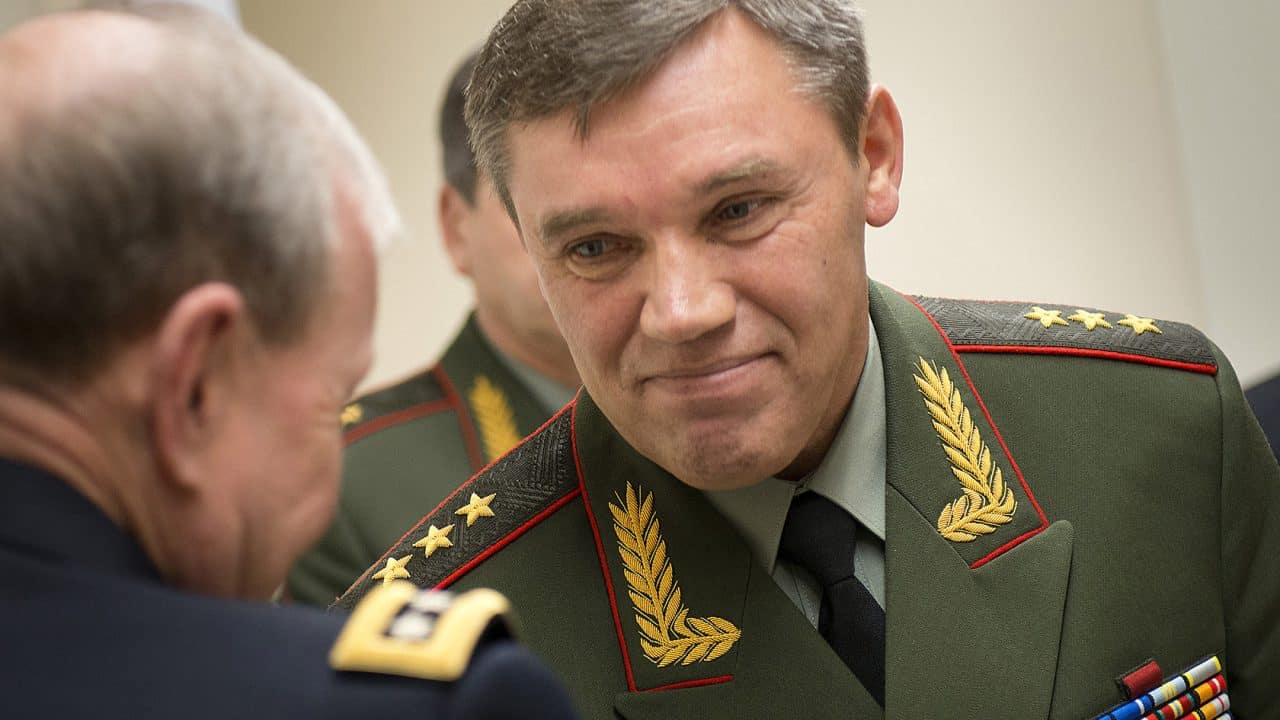
Main image: Chairman of the Joint Chiefs of Staff U.S. Army Gen Martin E. Dempsey, left, and Chief of the General Staff of the Russian Armed Forces Gen. Valery Gerasimov meet at NATO Headquarters in Brussels Jan. 16, 2013. (D. Myles Cullen via DoD)


Leave a Reply