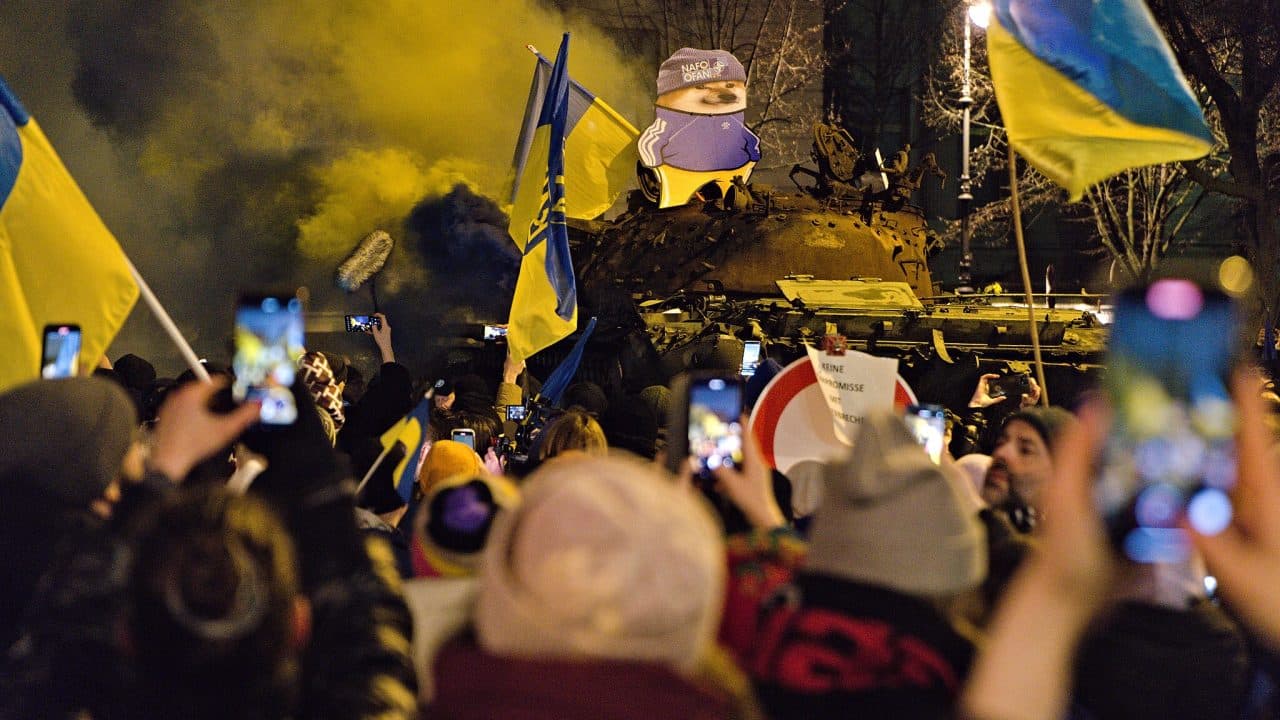
Since February 2022, Russia has focused its war effort across numerous fronts, one of which is informational warfare. Throughout the past two years, Russia has found success in spreading disinformation to undermine support for Ukraine in the West. The information battlefield is equally as important as the physical battlefield, as the capture of the hearts and minds of the Western public directly connects to the battlefield aid given to Ukraine. One online group that has been trying to fight Russian disinformation and rally support for Ukraine has been the North Atlantic Fellas Organization (NAFO).
Modern military battlefield strategy today is always accompanied by irregular warfare efforts such as disinformation campaigns. NAFO offers a valuable asymmetric approach to undermining Russia’s vastly superior state-sponsored propaganda, demonstrating the potential of internet movements as unconventional methods. For future battlefields, NAFO offers a useful case study in irregular warfare, particularly in the informational environment.
Russia’s Information Offensive
US House Foreign Affairs Committee Chair Michael McCaul previously said that “Russian propaganda has made its way into the United States.” Arguably, it played a role in delaying US aid to Ukraine at a critical juncture in the war earlier this year, enabling a series of battlefield gains by Russia that Ukraine is still struggling to stall. Without US aid, Ukraine was forced to withdraw from the stronghold of Avdiivka in February 2024.
Russian state interests have also been working with influencers in the United States to promote anti-Ukraine messages to undermine support for Ukraine. In September 2024, Tenet Media, a Tennessee-based company, was identified as a firm allegedly funded by Russian operatives as part of a Kremlin influence campaign targeting the 2024 US election. The company is linked to prominent right-wing commentators with millions of followers, including Benny Johnson, Tim Pool, and Dave Rubin. Prosecutors claim Russian state media funneled nearly $10 million to Tenet Media to spread pro-Russia propaganda, including content supportive of Donald Trump and other Kremlin-friendly figures. With a loyal fanbase, the influencers had around 6 million combined followers on YouTube alone.
Secretary of State Antony Blinken also revealed new US intelligence findings, stating that the Russian government had quietly embedded an intelligence-gathering unit within RT (formerly known as “Russia Today”) to promote propaganda to achieve these goals. Meanwhile, Anastasia Trofimova, a former employee of RT, produced a documentary titled Russians at War, which promoted pro-Russian narratives. The project received partial funding from the Canadian government through the Canada Media Fund, which contributed $340,000 via its broadcaster envelope program. In parallel, with the controversy surrounding the film, news emerged that RT, where Trofimova had been a former employee, was involved in influence operations and was acting as “an extension of Russian intelligence services.”
Initially, the film was slated for screening at the Toronto International Film Festival (TIFF). There was a significant public outcry against what many saw as an attempt to push pro-Russian propaganda, and the screening was suspended. However, within a week, TIFF opted to resume screenings of the film. Among those who led the effort to suspend the screenings were the NAFO fellas. NAFO members of the Ukrainian-Canadian diaspora like the user “@CanadianKobzar” on X, formerly known as Twitter, helped to rally other members to join protests against the film’s screening.
The film’s producer, Sean Farnel, went on various rants, blaming NAFO members for “canceling” the film and even alleging that they had threatened violence to stop the screenings on the social media platform X. Originally, NAFO targeted Trofimova, the film’s director, but when Farnel engaged with the group in a hostile manner, the situation escalated. In response, NAFO launched a relentless “meme and bonk” campaign against both Farnel and the film.
Who Are the NAFO Fellas?
Ever since the start of the full-scale invasion, Ukraine’s defense has been a fight of everyday people. In that spirit, the North Atlantic Fellas Organization (NAFO) is a social media movement that has taken up digital arms by using humor—primarily through memes—to combat and debunk Russia’s state-sponsored disinformation and raise awareness about the conflict.
While Russia has historically relied on disinformation as a vector to disseminate false narratives, NAFO has successfully harnessed the power of credibly sourced information paired with humorous memes. By ridiculing Russian propaganda, NAFO disarms it. An enduring motif among NAFO participants is the portrayal of their online accounts as actual Shiba dogs and other creatures, poking fun at the idea held in many anti-Ukraine circles that they are operatives of the US Central Intelligence Agency (CIA). Profiles associated with NAFO on social platforms often list “[redacted]” under employer details and cite “Langley, VA” as their location. This facetious narrative acts as a playful “open secret” so absurd that it traps opponents into appearing irrational when they allege that NAFO receives CIA backing, thus turning the tables on propagandists by using their tactics against them. The pro-Russian commentator Kim Dotcom even went as far as saying that NAFO fellas are “social media terrorists funded by the CIA.”
Another strength is the movement’s decentralized nature. Unlike Russia’s reliance on paid troll factories, NAFO benefits from global volunteers—calling themselves “fellas”—who have the freedom to respond creatively and with personal conviction. Anyone with an internet connection and a desire to counter misinformation can join the effort, providing NAFO with a diverse, dynamic, and all-volunteer force. The social nature of the group attracts new members, providing continuous growth and the infusion of fresh ideas. This fluidity makes NAFO an unpredictable and formidable opponent in the information war that proves challenging for its adversaries to destabilize. Vasyl Myroshnychenko, Ukraine’s Ambassador to Australia, stated that “NAFO is impossible to undermine,” adding: “It is decentralized; it’s just a group of random people.” With no central leader to target and no technical infrastructure to hack, Russia cannot stop its collective force. However, there is an argument that greater organization could increase its effectiveness.
During the early stages of the full-scale invasion, NAFO effectively identified and countered Russian disinformation, thereby countering the anti-Ukraine narrative pervasive in some media circles. NAFO fellas mocked Russia’s top diplomat in Vienna, Mikhail Ulyanov, who found himself at the center of a social media storm after responding to NAFO profiles that criticized his promotion of Russian propaganda. “You pronounced this nonsense, not me,” Ulyanov wrote before leaving the platform for several weeks.
Nonetheless, apart from Russia, even American officials have attempted to target NAFO. Former Trump administration official Elbridge Colby also got into an online spat with NAFO members that ridiculed him. By August 2024, US Senator Mike Lee of Utah promoted a theory put forth by the pro-Kremlin commentator Kim Dotcom, suggesting that NAFO “was actually a CIA-backed operation run by former congressman Adam Kinzinger.” Colby followed up, doubling down on claims that the dog memes being produced by NAFO are being funded by the CIA.
NAFO’s Battlefield and Information Warfare Burden Sharing
Andriy Yermak, Head of Ukraine’s Presidential Office, recently recognized NAFO’s online campaign, stating, “A massive shoutout to the incredible NAFO Fellas for your unwavering support of Ukraine! Your ongoing fight for truth and against disinformation is of immense importance. Together, we are stronger!” NAFO’s success has been so significant that RT, the Russian state media outlet, tried attacking NAFO by labeling it a pro-Ukrainian “bot army.” In July 2023, Russia’s foreign ministry spokeswoman personally took the time to attack NAFO, showcasing how a bunch of random people masked as cartoon dogs on social media occupy the mental real estate of the Kremlin elite.
NAFO’s impact extends beyond the digital realm. They have been instrumental in fundraising efforts, supporting Ukraine’s war effort by purchasing drones, vehicles, tourniquets, electronics, and other equipment. These contributions have tangible effects on the ground, providing much-needed support to Ukrainian forces. Many NAFO members “adopt” units in Ukraine and maintain communications with Ukrainians on the front lines to respond to real-time requests. The NAFO fellas helped raise hundreds of thousands of dollars to fund naval drones through United24. Due to the “fellas” being decentralized, it is nearly impossible to quantify their total impact on fundraising. However, it wouldn’t be far-fetched to estimate it to be at several million dollars, if not in the tens of millions already.
Paul Lushenko, Assistant Professor and Director of Special Operations at the U.S. Army War College, noted, “Memes are helpful to bolster public support.” He further highlighted that “Memes will continue to play a supporting role to what goes on the battlefield.” We have seen this play out live as Ukraine went on the offensive, invading Russia in August 2024. Pro-Kremlin commentators like David Sacks were stunned by Ukraine’s invasion of Russia, and it took him over a week to comment on the event. NAFO and the pro-Ukrainian community began ridiculing David and others like him who were promoting Russian talking points and utilizing memes to help continue bolstering online public support for Ukraine.
Carl von Clausewitz emphasized the military concept of the “fog of war.” War brings a great amount of volatility, uncertainty, complexity, and ambiguity. What NAFO does about information warfare shows a new battleground where irregular warfare occurs through non-traditional methods and tactics—such as digital campaigns, “meme warfare,” and decentralized coordination. These elements are employed to combat a conventionally superior adversary in terms of state-backed propaganda resources. Clausewitz acknowledged the efficacy of using asymmetric tactics in confronting a stronger foe, suggesting that the weaker party must adopt unconventional methods to exploit the enemy’s vulnerabilities. NAFO’s online presence does precisely this, turning the perceived strength of Russian propaganda into a vulnerability by neutralizing its effect through mockery.
Making Global Decentralized Information Warfare Global
This concept of decentralized information warfare also mirrors the challenges faced by other nations like Taiwan, which contends with China’s “Wolf Warrior diplomacy” and the “50 Cent Army.” These entities employ disinformation and cyberattacks to manipulate public opinion and maintain a narrative favorable to the Chinese government. Like NAFO’s efforts to combat Russia, there is a need for a similar, decentralized entity to counter Chinese information warfare.
Some have pointed out that in the event of a Chinese invasion of Taiwan, a movement similar to NAFO could arise to support the democratic forces behind Taiwan.
NAFO’s approach—leveraging humor, community, and a decentralized structure—offers a potential blueprint for future conflicts where digital information warfare plays a pivotal role. While NAFO might not fight in information battles beyond the war in Ukraine, it has certainly kick-started an evolutionary process and clearly shown how decentralized communities based in the democratic world can effectively resist the disinformation campaigns employed by authoritarian adversaries.
David Kirichenko is an Associate Research Fellow at the Henry Jackson Society, a London-based think tank. His analysis is widely published in outlets such as the Atlantic Council, Center for European Policy Analysis, and The Hill, as well as in peer-reviewed journals. He can be found on the social media platform X @DVKirichenko.
The views expressed are those of the author(s) and do not reflect the official position of the Irregular Warfare Initiative, Princeton University’s Empirical Studies of Conflict Project, the Modern War Institute at West Point, or the United States Government.
Main Image: Destroyed Russian tank with NAFO “fella” in front of Russian embassy in Berlin. (Photo by Leonhard Lenz via Wikimedia Commons)
If you value reading the Irregular Warfare Initiative, please consider supporting our work. And for the best gear, check out the IWI store for mugs, coasters, apparel, and other items.


Nelly Ostrovsky says
Well done! Thank you!
Lisa Farrar says
Thank you so much for writing this detailed article about how the fellas make a difference. And I think you’re correct in saying that fellas may have raised and continue to raise many, many millions of dollars to help Ukraine.