
Editor’s Note: This article is adapted from “Counterinsurgency as order-making: refining the concepts of insurgency and counterinsurgency in light of the Somali Civil War,” published in Small Wars and Insurgencies.
Civil war is a complex, messy and intensely political phenomenon whereby established orders are challenged and new ones produced. The scholarly undertaking to understand, explain and at times predict such messes is difficult at best, yet the prevalence and impact of the former, current and future civil wars compel us to do our best. In this quest, the academic literature on insurgency and counterinsurgency, which quickly lost popularity after US failures in Iraq and Afghanistan has nevertheless provided vital insights into and knowledge about why insurgencies emerge, how they endure and how they end, and how governments succeed or fail in defeating them.
However, the insurgency and counterinsurgency discourse are dominated by concepts that are too narrow and isolated from the burgeoning literature on the wider phenomenon of civil war within which insurgency and counterinsurgency occur. Rather than accounting for the complex political processes and wide range of forces and actors that shape conflict dynamics, the dominant insurgency and counterinsurgency debate tends to reduce highly messy contexts to the often false dichotomy of insurgents and counterinsurgents, usually understood as the state versus one or more violent non-state actor. In reality, governments and violent non-state actors are only some of a conglomerate of other actors, institutions and forces shaping conflict dynamics. The recognized governments themselves may even be the ones challenging order exercised by a ‘non-state’ armed group, or they may cooperate with one or more non-state challengers in some areas while fighting them in others. The identity of the challenger (‘the insurgent’) and the ones consolidating established order (‘the counterinsurgent’) may fluctuate considerably throughout the same conflict.
In our recent article in Small Wars and Insurgencies, we argue that orthodox reductionist concepts and assumptions underpinning the dominant insurgency and counterinsurgency discourse provide limited value in understanding the complexities of civil wars. Building on recent critical literature on insurgency and counterinsurgency, we propose a refined conceptualization of both terms. Instead of conceptualizing insurgency and counterinsurgency as peculiar forms of war, strategies or sets of guerilla tactics, we follow Jaqueline Hazelton and understand insurgency and counterinsurgency as elements of violent order-making. Thus, insurgency and counterinsurgency are, in our view, comprehensive processes of organized challenge to and consolidation of established political order within the context of civil war. By emphasizing the politics of order-making, the dynamics of violence are foremost seen through the lens of domestic power competition, whereby the intensity of violence and identities of insurgent and counterinsurgent largely follow the dynamics of elite competition and the effects of elite bargaining on the ground. To illustrate our argument, we draw on the highly complex landscape of the ongoing civil war in southern Somalia.
Counterinsurgency as order-making
Criticism of the orthodox insurgency and counterinsurgency discourse that reemerged in the US in the mid-2000s is old news. But the view that insurgency is a distinct kind of war, and that counterinsurgency is the remedy to cure the problem, still dominates discourse. We instead embrace the works of Jaquelin Hazelton, David Ucko and other critics and offer a refined view of the concepts.
According to Hazelton, insurgency and counterinsurgency are primarily a domestic political process of violent state-building. While international actors and states may intervene in intra-state conflicts, political order largely arises from domestic elite efforts to triumph in violent political rivalry. Contrary to the assumptions of the orthodox counterinsurgency discourse, Hazelton stresses that elite groups rule to protect their own interests, not those of the populace. Once elites have determined through violent competition which of them will dominate the rest, and at what cost to which actors, political stability will follow – as long as the elite bargain holds.
Hazelton’s conceptualization has, in our view, several theoretical implications. First, ‘insurgency’ must first be understood as an element of violent domestic state-building processes in the form of the actors striving to seize or transform the dominant political order. Second, it does not distinguish between the weak and the strong or reduce counterinsurgency to a specific type of strategy or tactic which, as previously noted, may fluctuate throughout the same conflict. Third, it emphasizes the political nature of violent struggle. How the authorities decide to manage challenges to existing order largely depends on the dynamics on the ground. For example, it may be that authorities are focused more on other issues than on fighting the insurgents, such as accommodating local elite groups. It may even be the case that the authorities care little about insurgent violence and atrocities against civilian communities as long as the mechanisms upholding their power position remain in place. In what Ucko terms rural “localized insurgencies,” the violent challenger may thrive on the periphery, controlling considerable territories and populations, if their activity remains below a certain threshold and is not seen as a direct threat to the incumbent state’s elites. Or the opposite may be the case: the established authorities, feeling threatened, are willing to crush the insurgents by any means possible, as in the case of the Tamil Tigers (LTTE) in Sri Lanka.
Counterinsurgency and civil war
One can study insurgency as a phenomenon independent from civil war. However, given a broad understanding of civil war as a “situation where a government faces a violent challenge by one or more rebel actors over some articulated goal of political change,” most visible insurgencies and counterinsurgencies operate within the larger context and complexities of civil war. Thus, research on insurgency/counterinsurgency will benefit from the extensive civil war literature and rich debates on political violence more broadly. For example, where orthodox counterinsurgency discourse treats ‘the population’ as an aggregated and oversimplified category, to be won over by coercion and/or provision of governance and socioeconomic reforms, a quickly growing body of literature within civil war studies demonstrates the multifaceted roles of civilian communities.
Recent civil war literature also suggests the dichotomy between non-state and state may be unclear and even unnecessary for meaningful analysis. There may well be cases where the internationally recognized government is the one that challenges the established order in territories ruled by non-state authorities. Likewise, studying counterinsurgency calls for exploring the actors, institutions and forces striving to safe-guard the status quo within the wider context of civil war. Recognized governments, non-state armed groups, non-combatants, criminal organizations, intervening organizations and states etc. all play into these processes in various ways, some spurring change, others striving to defend established order. Instead of focusing solely on how a government with or without external support moves on to defeat its non-state challenger(s), in line with orthodox views, studies of counterinsurgency now become a broad effort to grasp how established forms of order in civil conflicts may or may not withstand armed challenge, including political and military strategies applied by the dominant players, be it states or non-state groups.
Civil war in southern Somalia
The new conceptualization highlights the complex political processes surrounding elite competition, where outright fighting between established authorities and one or more opponents may be only one, and perhaps a less important, manifestation of the ongoing contest for dominance. In southern Somalia, where state authority has been essentially absent since the downfall of the dictator Siyad Barre in January 1991, lasting authority has not been the rule. Authority and order have been continually co-produced and reproduced by a wide variety of actors and institutions contesting dominance. The ones consolidating established order (the ”counterinsurgents”) and the ones challenging it (the “insurgents”) have varied extensively over time within a “mosaic of power,” or a multiplicity of political power structures coexisting within one national space in which strategy and tactics applied by the actors have changed according to developments in the conflict dynamics.
Despite massive international support in the form of international aid, political and military assistance, and several military interventions, Somalia still comprises a mosaic of power and is far from a central state in the Weberian sense of the term. The most successful actor, in terms of controlling territory and populations, has been the militant Islamist group al-Shabaab. The group established a brutal, yet largely functional proto-state in most of South-Central Somalia between 2008 and 2011 under a central leadership and comparatively sophisticated bureaucracy. Al-Shabaab still dominates large rural areas in southern Somalia.
In the recognized Somali federal member states, the struggle between militant Islamists and provincial governments is still visible and the power balance of the contesting parties has varied extensively over time. While the military threat from the Islamists may be obvious the provinces’ political elite, often political (and sometimes military) struggles with the federal government in Mogadishu and/or opposition by key local political rivals may be existential and largely overshadow military initiatives. For international partners pursuing a military approach to defeat al-Shabaab, lack of local initiatives and military progress against militant Islamists may be frustrating. Yet, seen through the lens of counterinsurgency as order-making, it may make sense for the provincial governments to deprioritize military operations against al-Shabaab. If the group is not deemed an immediate and existential threat to the established elites’ power position, the local authorities are best served by focusing their attention and resources elsewhere. For provincial government elites, it may be far more pressing to forge and maintain local alliances and keep the federal government in Mogadishu at bay than to fight al-Shabaab through a costly military campaign. In Somalia’s southernmost member state, Jubaland, al-Shabaab is indeed the immediate military challenge to the local government within its province. However, the survival of the current elite constellation in Kismayo is primarily a political concern. As long as Jubaland continues to enjoy military support from Kenya, the Jubaland government’s objective is at least threefold. One, to meet the interests of its established power base, which centers on support from an alliance of Ogadeen clan elites and other key clan elites in the south. Two, to negotiate and partly counter elements from opposing elite groups, especially those of the large Marehan clan group in the Gedo province, the northernmost province of Jubaland. Three, to counter the federal government and central elite groups in Mogadishu, which strive to project their central powers throughout the entire federal state and, not least, to expand their revenue base to include the strategic harbor in Kismayo, Jubaland’s capital. The current Jubaland President, Ahmed Madobe, has few incentives to focus on the military campaign against al-Shabaab. If Madobe pushes al-Shabaab further out of its remaining strongholds, he may lose more politically than he would gain, despite tactical successes against al-Shabaab on the battlefield. Elite groups in newly conquered areas, hosting a wide range of non-Ogadeen clan groups as well as historically traditional intra-Ogadeen rivals, may strengthen or alter established alliances unfavorable to the current Jubaland government. For Ahmed Madobe and his elite alliance, counterinsurgency is thus exercised through political maneuvering and cooptation, not primarily through the gun nor the popular support of the people.
The ambiguities and politics of civil war
In southern Somalia, the actor or alliances of actors who constitute established authority (the counterinsurgent) and the challenger (the insurgent) have constantly fluctuated. In such contexts, the labels of state and non-state often give limited analytic meaning. The story of current Jubaland President, Ahmed Madobe, is illustrative. Previously an Islamist commander fighting alongside al-Shabaab, Ahmed Madobe later clashed with al-Shabaab and took the lead as a clan-based militia commander, until he managed to ally with Ethiopia and Kenya, finally ending up as selected President in the newly formed federal member state. The stateness of Jubaland, in contrast to the quite centralized al-Shabaab, may not be analytically obvious. While the categories of state and non-state carry political and moral weight in constructing our sense of reality through discourse, reasonable analysis of conflict dynamics and patterns should strive for a more nuanced understanding.
We support the strand of literature that propagates the political nature of war. Any intervention into highly political civil war contexts influence a wide range of dynamics and relationships, which are often difficult, if not impossible, for outsiders to fully understand. Nevertheless, we hope that viewing counterinsurgency through the lens of domestic order-making, may serve as a starting point to move beyond reductionist and static categories as well ideas about pre-defined solutions.
Michael W. Skjelderup has published several peer-reviewed articles on Somalia, insurgency, counterinsurgency and rebel governance. In 2021, he receieved a PhD in International Environment and Development Studies, Ås, Norway, on rebel governance and insurgency in southern Somalia. He has travelled extensively on the Horn of Africa. Field trips to Kismayo, Mogadishu, and Nairobi make up a major part of his research effort.
Mukhtar Ainashe has been engaged with the Somali conflict and politics for years and has held advisory roles within the Somali government and for non-governmental organizations. He holds an MA and MPhil and has previously co-authored articles conflict dynamics in southern Somalia.
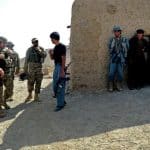
Photo caption: AMISOM special forces soldiers outside Somalia Parliament building after foiling an attack by Al-Shabaab on 24th May 2014/AMISOM public affairs



Leave a Reply