

Editor’s note: This article is part of Project Air Power, which explores and advocates for the totality of air, aviation, and space power in irregular, hybrid, and gray-zone environments. We invite you to contribute to the discussion, explore the difficult questions, and help influence the future of air and space power. Please contact us if you would like to propose an article, podcast, or event.
In the heart of Southeast Asia, a desperate struggle for power has been unfolding. The Burmese (Myanmar) military junta, facing its most significant challenge since seizing control in 2021, is struggling to maintain its grip on the country. As rebel forces gain ground, the junta has needed to rapidly modernize its approach to the threats posed by Burmese groups opposed to the regime.
Recent research conducted at the Global Disinformation Lab (GDIL) at The University of Texas at Austin has shed new light on the junta’s drone pursuits. Through analysis of commercial satellite imagery, ground photography, and open-source intelligence, our team has pieced together a clearer picture of Burma’s drone program. Our findings form the backbone of this article, offering new insights into the junta’s military aspirations and the stark realities on the ground.
https://irregularwarfareinsider.podbean.com/
For irregular warfare practitioners, this analysis offers several insights. It highlights the increasing accessibility of drone technology to non-state actors and authoritarian regimes, emphasizing the need for adaptive counter-drone strategies. The case of Burma demonstrates how even technologically limited actors can leverage a mix of foreign-sourced drones and domestically produced munitions to significant effect. Furthermore, it underscores the importance of comprehensive intelligence gathering on adversaries' drone capabilities, including their supply chains and manufacturing processes. Lastly, it serves as a reminder that in modern conflicts, the technological playing field is rapidly leveling, necessitating constant innovation in offensive and defensive irregular warfare tactics.
In the past, the junta has harbored dreams of joining the ranks of nations capable of producing advanced unmanned aerial vehicles (UAV). The allure is clear: combat drones offer a potent mix of surveillance capabilities and striking power, at a fraction of the cost of traditional manned aircraft. In an era where irregular warfare is increasingly common, drones have become a game-changer on battlefields worldwide.
However, Burma’s attempts at domestic drone production have been fraught with setbacks. In place of their grandiose manufacturing plans, the junta has turned to foreign suppliers like Russia, China, and Iran to support their efforts.
The Seeds of Ambition
The roots of Burma's drone aspirations can be traced back to the early 2000s when a video showed the alleged first flight of a UAV at an air base near Rangoon (Yangon). Soon after, the Myanmar Aerospace Engineering University (MAEU) began its UAV research and development program. Early drone prototypes, with the names “UX-1” and “UX-2M”, showed promise—at least on paper. These fixed-wing designs resembled simple remote-controlled planes, a far cry from the sophisticated combat drones employed by major military powers.
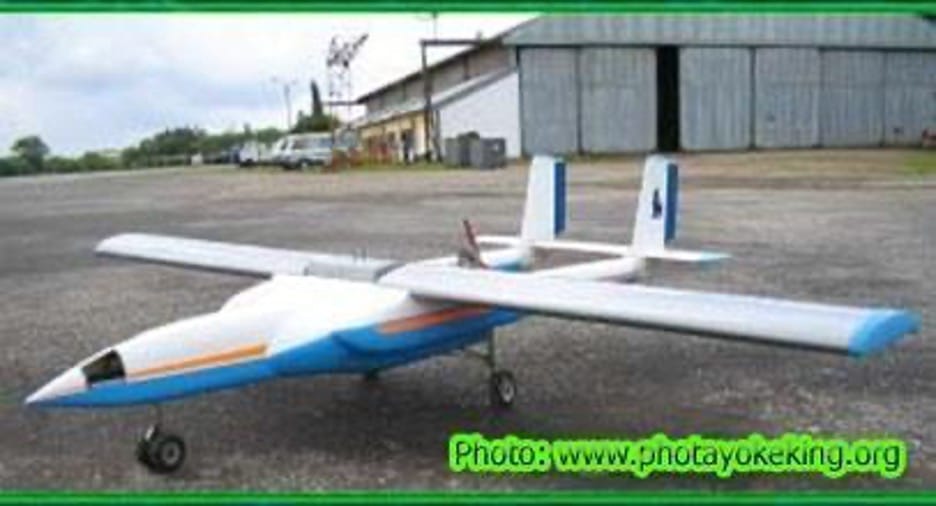
The UX-1 UAV. Source: Leak from “Naing Naing Sanay Myanmar News”
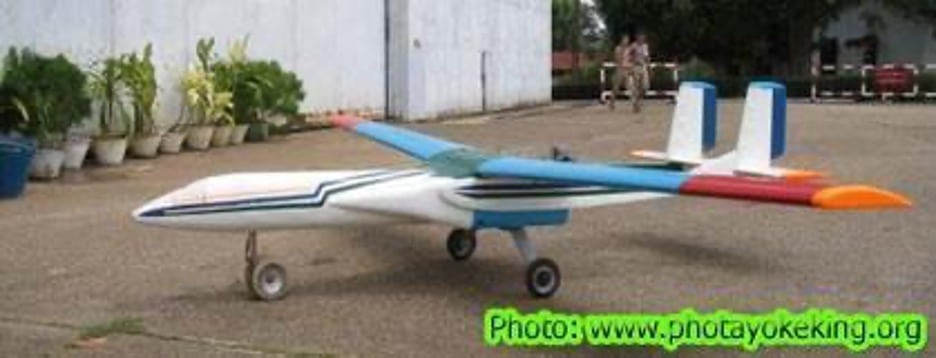
The UX-2M UAV. Source: Leak from “Naing Naing Sanay Myanmar News”
As the years progressed, the Burmese military, which has remained essentially the same through successive governments, has taken a keen interest in UAV development, seeing potential applications in air defense training, battle damage assessment, and surveillance. Collaboration between the MAEU and the Burmese Air Force intensified, with uniformed personnel observed looking over prototypes and satellite maps and discussing drone applications.
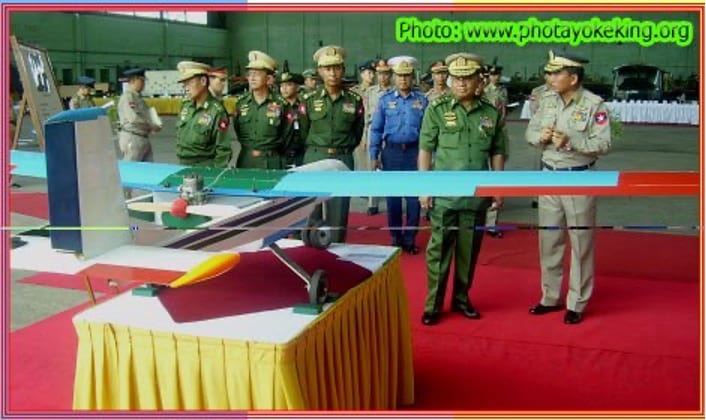
Burmese military personnel looking over an early UAV. Source: Leak from “Naing Naing Sanay Myanmar News”
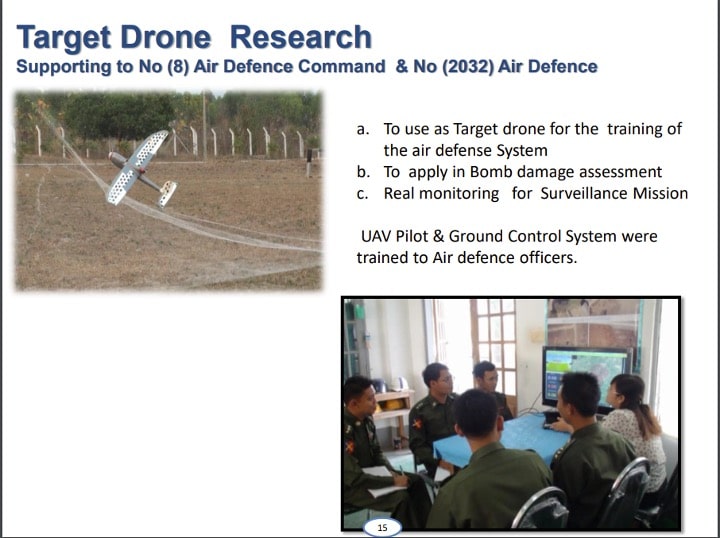
MAEU collaboration with the Burmese air force (identified by their arm patch). Source: PowerPoint released by the MAEU
Aspirations vs. Reality
Despite initial signs of progress, Burma's actual achievements in combat drone production were limited. The only claimed victory for the junta’s UAV program is the “Yellow Cat” or “Yellow Bird.” This drone has been a source of confusion, as it has been described on separate occasions as a domestic variant of both the Chinese CH-3 and Chinese Sky-02 UAVs.
Early models of the Yellow Cat were simplistic, lacking the sophisticated sensors, controls, aerodynamic refinements, or payload capacities of its supposed Chinese counterpart.
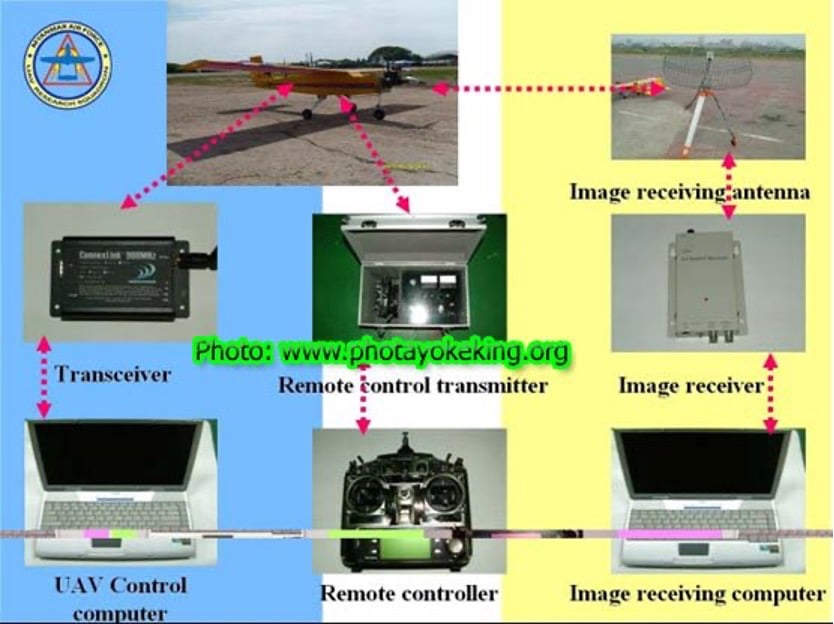
Images of the Yellow Cat UAV in 2007. Source: Facebook
The above image is the latest publicly available information on the UAV, meaning the drone’s design and capability have likely evolved. Since then, the only reference to the Yellow Cat’s existence was in 2022, when rebel Telegram scouting channels reported its sightings.
However, in May of 2021, a crashed UAV was photographed in Mandalay. Conflicting claims state that this drone was the domestically produced Yellow Cat while others report it as the Chinese-made “Sky-02.” The junta has been confirmed to operate the Sky-02, but features of the crashed drone do not align, particularly with the undercarriage and the tail’s connections to the wing.
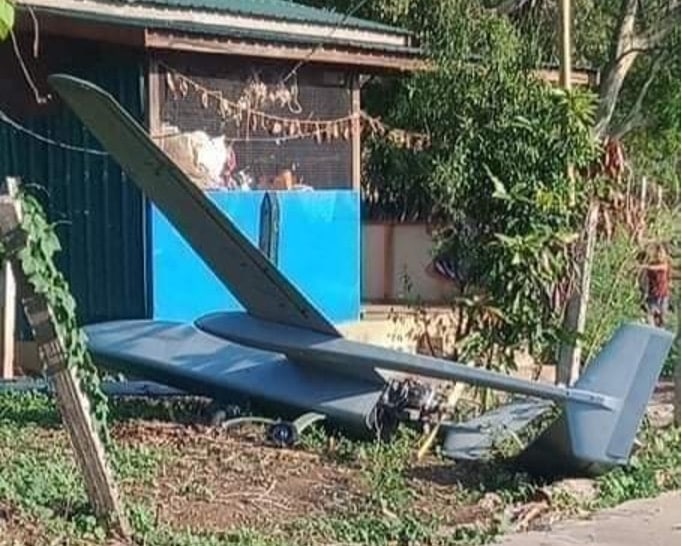
Crashed drone in Mandalay. Source: X
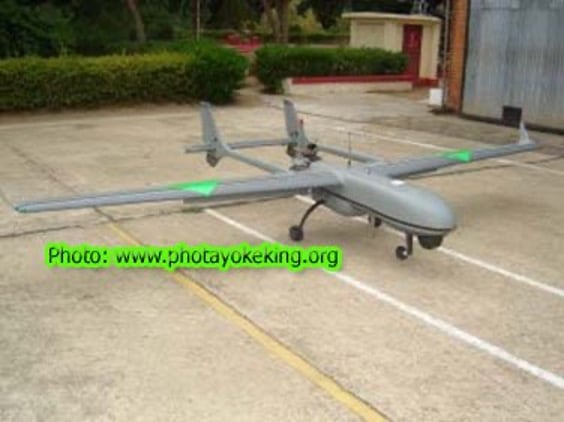
2012 image of the Sky-02 in Burma. Source: Facebook
This lends credence to the possibility that the crashed UAV was indeed a domestically produced variant of a Chinese drone. If true, this indicates some success in the UAV program’s practicality in post-coup Burma, but the fate of this particular drone suggests a struggle to perfect the technology.
The crashed drone may be the only remaining remnant of the junta’s dreams to produce drones domestically. Reports on the UAV production program have been almost nonexistent since 2012, and after the 2021 coup, the MAEU has likely been hesitant to collaborate with the junta on research and development. The program has fallen short of its lofty ambitions.
This gap between aspiration and reality is a persistent theme in the Burmese military’s self-sufficiency efforts. The junta has shown some success in assembling aircraft like the K-8, and manufacturing a trainer known as the “MTX-1A”, but their big plans for local production of the Austrian-designed DART-450 have been halted due to lack of parts. Furthermore, the junta still depends on foreign suppliers for more sophisticated manned aircraft, such as the recently acquired Su-30.
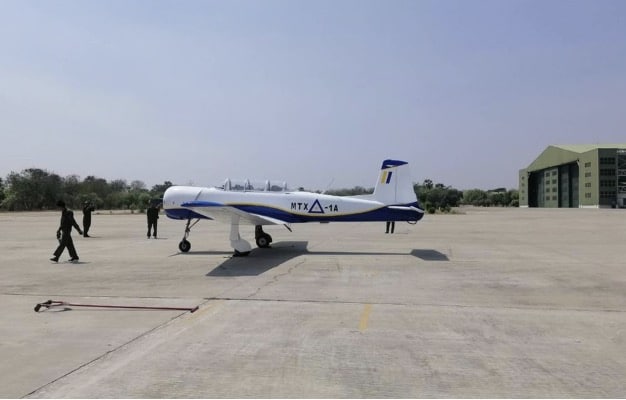
Burma’s “MTX-1A”, produced domestically. Source: Facebook
A Web of International Connections
Because Burma’s aircraft production capabilities do not match its needs, they have turned to a rogues’ gallery of international partners to aid in their pursuits.
China has been crucial for Burma’s drone ambitions. According to a Stockholm International Peace Research Institute (SIPRI) report, China supplied 12 CH-3 drones to the junta between 2014 and 2015. The CH-3s are medium altitude, long-endurance fixed-wing craft with payload, thermal imaging, and strike capabilities developed by the Chinese Aerospace Science and Technology Corporation (CASC). They have been spotted at Shante Air Base near Meiktila, where they serve as tools to monitor protests and likely play a prominent role in the surveillance of rebel activities.
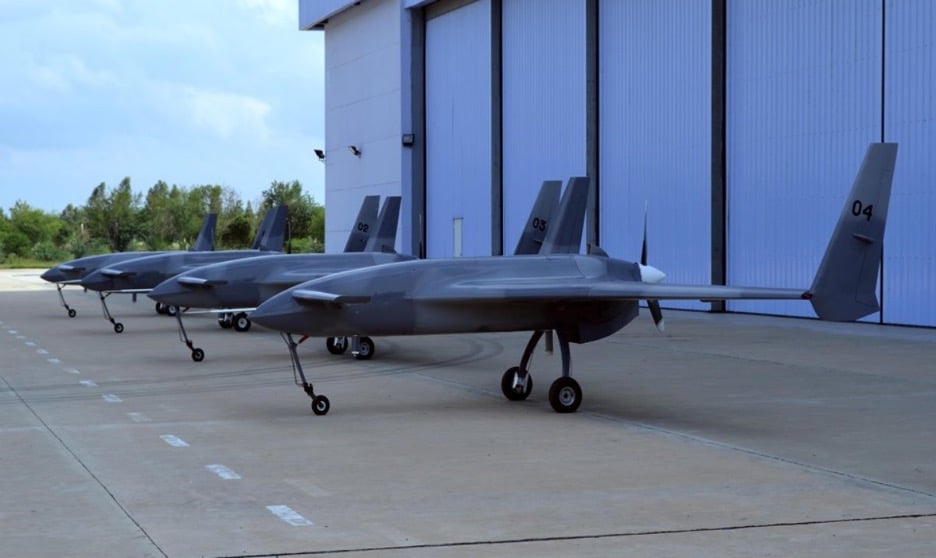
Chinese CH-3 drones at Shante airbase. Source: China Defence
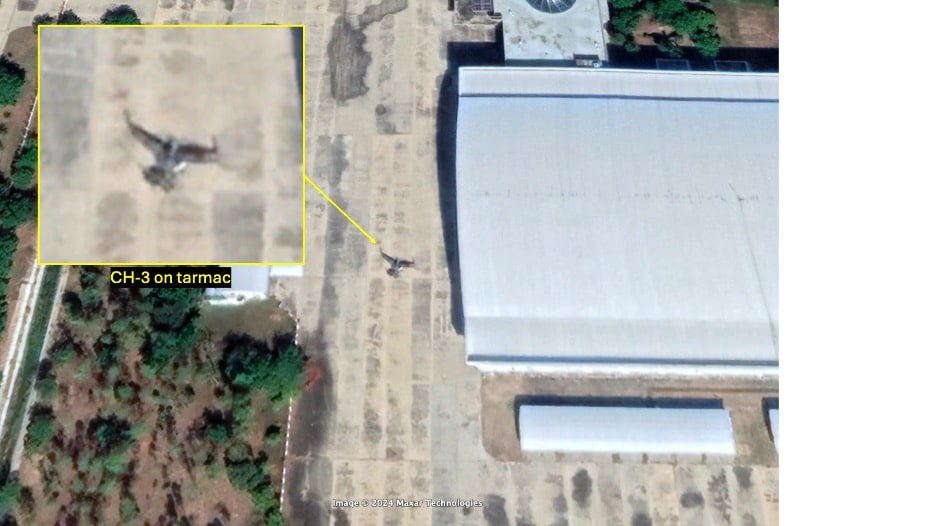
A CH-3 visible on satellite at Shante airbase. Copyright Google Earth 2022.
Furthermore, there have been reports of the Chinese CH-4 being used by the junta. The CH-4 builds on its predecessor with a longer flight endurance and increased payload capacity. A report by Radio Free Asia claimed that the Burmese military recently acquired CH-4s, and has been using them in operations as recently as April. However, GDIL found no photo or video evidence to validate these claims.
The regime has also turned to Russia to pursue its goals. In 2021, Moscow sold an unspecified number of Orlan-10E drones to the junta. The Orlan-10E is Russia’s export variant of the Orlan-10, a small surveillance UAV with data collection, reconnaissance, and electronic warfare capabilities. Crashes have confirmed their presence in Burma.
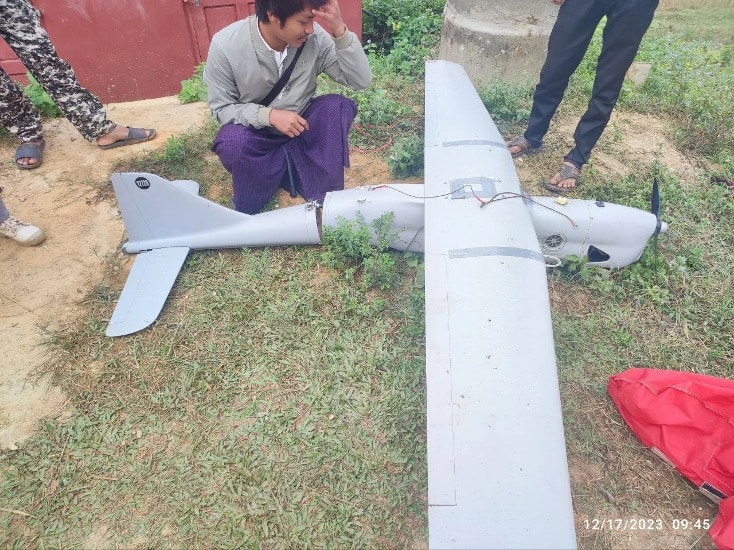
A crashed Orlan-10E allegedly in Northern Sagaing. Source: Reddit
While Russia has been one of Burma’s most important weapon suppliers for years, the two regimes appear to be getting even closer. Earlier this year, state media footage showed the junta’s Director of Procurement examining drones in Russia. It has since been rumored that this visit resulted in the purchase of more Orlan-10 and new Orion-2 UAVs.
Iran, too, has played a part in Burma's drone saga. In January 2022, a 747 from Iran was observed unloading mysterious crates at Naypyidaw International Airport. While the exact contents remain unconfirmed, an army defector claims that the shipment included drone engines or components—possibly to support the maintenance of Burma's existing UAVs which were showing wear and tear.
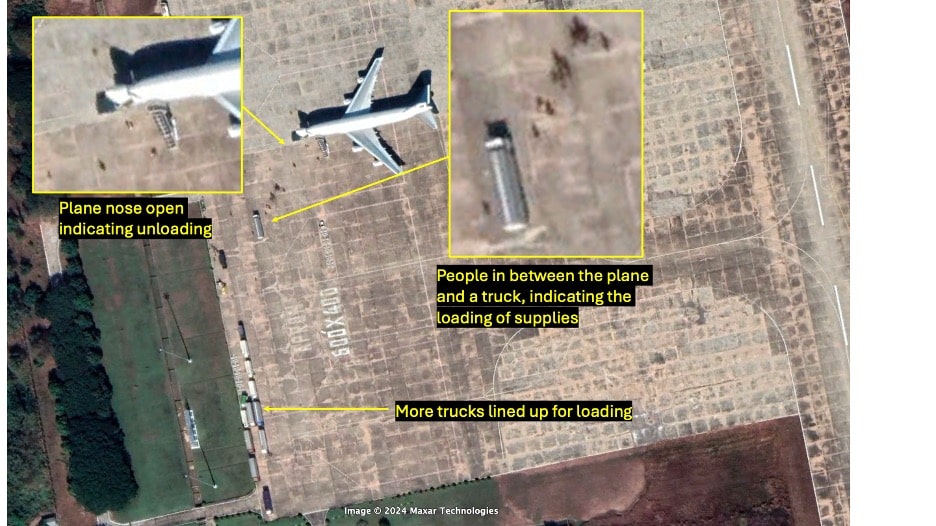
Imagery showing people unloading into trucks from an Iranian Fars Air Qeshm 747. The plane’s identity is confirmed by Flightradar24 data. Copyright Google Earth 2022.
These international pursuits highlight the junta’s desperation to acquire drone capabilities while emphasizing their inability to reliably develop these technologies indigenously.
Small Drones, Big Punch
Rebel groups have been operating small drones for years to great effect. These drones are cheaper, more intuitive, and easier to use than larger Chinese and Russian MALE UAVs, which require extensive training and technical know-how to operate and maintain. The junta has had no choice but to respond by bolstering their drone teams and expending precious resources on small unmanned aerial vehicles (sUAV). According to Min Zaw Oo, the executive director of the Myanmar Institute for Peace and Security, the Burmese military started to procure thousands of Chinese drones at the beginning of 2024.
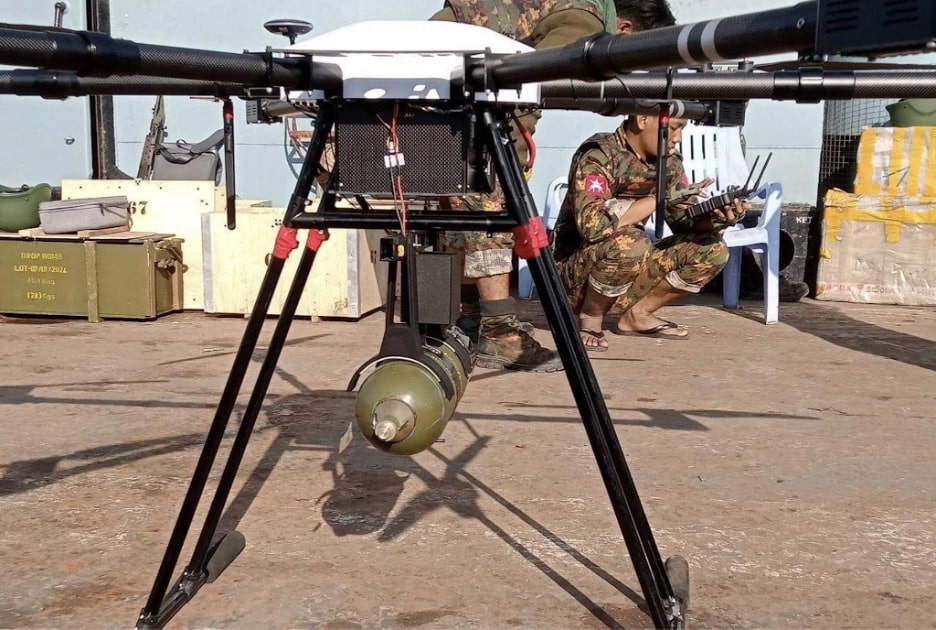
A repurposed agricultural drone carrying a drop bomb. Members of the Burmese military (identified by the arm patch) are seen in the background. Source: Reddit
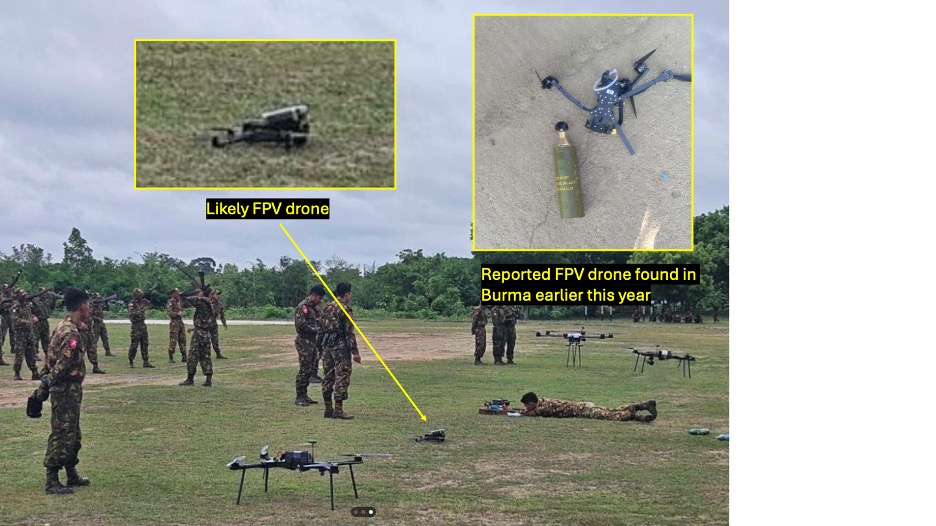
Burmese military training with agricultural drones and smaller FPV drones with munitions attached. Source:Reddit
Disturbing footage released by the Burmese military shows the newly acquired sUAV being used in combat – dropping small munitions onto unsuspecting targets. Notably, however, the bombs raining down on the rebels are being manufactured in the junta’s domestic production system. A report released by the Special Advisory Council last year details the junta’s arms production capability through their “KaPaSa” network. The findings provide information on markings that signify munitions produced by the junta.
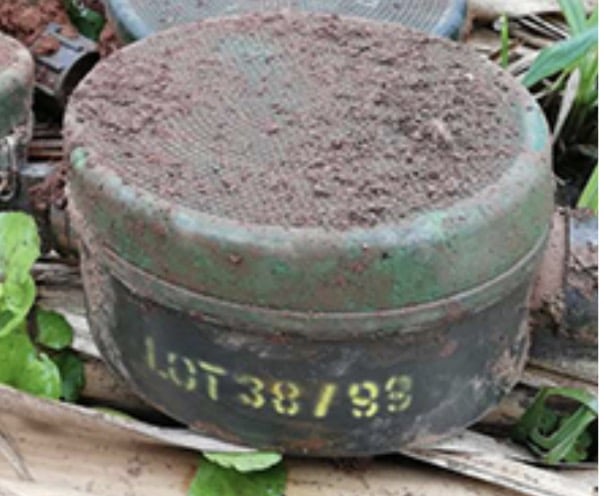
Landmines produced by KaPaSa factories. Source: Special Advisory Council Myanmar
One of the key indicators for junta munitions is the visible lot designation in a distinct bold yellow font, discernible on the landmine in the above image. These markings have recently been seen on junta crates labeled as “DROP BOMB”.
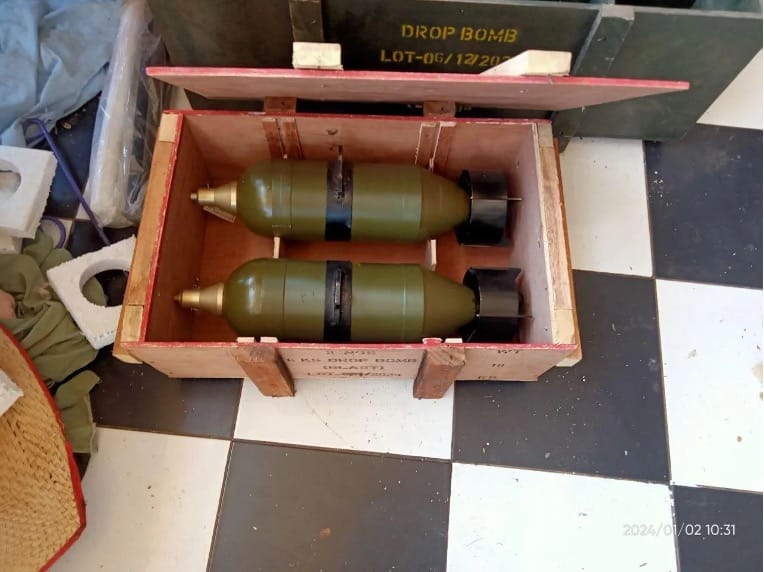
An image of junta bombs with the lot designation and KaPaSa font visible on the crates. Source: X
Additionally, these markings are visible on the previous image of the repurposed agricultural drone, verifying their usage with the newly acquired hardware.
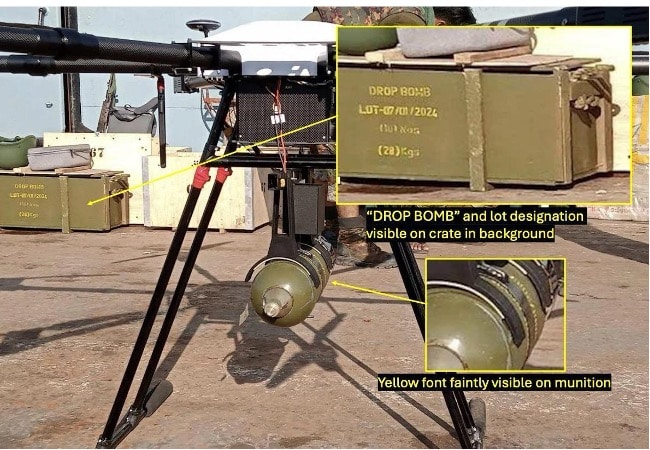
Drop bomb crate with lot designation and KaPaSa munition attached to drone.
This use of domestically produced drop bombs is a concerning development as it allows the junta to offset costs and subvert sanctions while continuing to apply pressure on rebel groups.
Lessons for the International Community
Burma’s drone pursuits offer valuable warnings for the international community:
1. Determined actors will seek military capabilities through any available channels. Despite sanctions and export controls, the Burmese regime has acquired a fleet of small, medium, and large drones. This underscores the need for more robust international cooperation to prevent the proliferation of sensitive technologies. However, actors like China, Russia, and Iran will continue proliferating drones, stunting any such cooperation.
2. Domestic industry can augment foreign equipment. The use of locally produced munitions in conjunction with imported drones suggests dangerous levels of customization and versatility. This highlights the importance of monitoring not just finished products, but also components and manufacturing capabilities.
3. The proliferation of drone technology complicates conflict resolution and supports repression. The junta’s use of drones to monitor protests and attack rebel groups sends a message to the rest of the world about the risks of this technology in the wrong hands. International bodies like the UN, EU, or ASEAN may need to consider new frameworks for regulating the export and use of drone technology.
Looking Ahead
As the junta continues its military modernization efforts, the people of Burma continue to suffer. The ongoing civil conflict has displaced 3.2 million people internally and created 1.3 million refugees. It has also devastated the economy and plunged the country into a humanitarian crisis.
Despite potential shortcomings with the junta’s domestic drone program, they have been able to take advantage of readily obtainable alternatives from foreign suppliers. However, as coordinated rebel military advances continue, the systems that support Burma’s drone fleet are in danger. The junta’s network of “KaPaSa” factories could become prime targets for opposition forces hoping to degrade the regime’s ability sustain its war effort.
Ultimately, the junta’s efforts to achieve drone supremacy indicate its drive for dominance. As the bloody war continues and the country teeters on the brink of transformative change, one can only hope that whatever government emerges from the current upheaval will choose a path of genuine development and reconciliation.
Beau Chapman is a rising junior at the University of Texas at Austin, majoring in Government and pursuing minors in Arabic and Philosophy.
Alexander Suster is a rising senior at the University of Texas at Austin, majoring in International Relations and Global Studies with a focus on Security and the Middle East and minoring in Hebrew and Business.
Steven Ahart is a rising senior at the University of Texas at Austin, majoring in International Relations & Global Studies and European Studies with a focus on International Security and US-German relations through his German language certificate.
The views expressed are those of the author(s) and do not reflect the official position of the Irregular Warfare Initiative, Princeton University’s Empirical Studies of Conflict Project, the Modern War Institute at West Point, or the United States Government.
Main Image: Delegation of Myanmar military junta. 10th international exhibition of arms and military machinery (Homoatrox via Wikimedia Commons)
If you value reading the Irregular Warfare Initiative, please consider supporting our work. And for the best gear, check out the IWI store for mugs, coasters, apparel, and other items.




.jpg?ref=irregularwarfare.org)