
From Ukraine to the South China Sea, the electromagnetic spectrum is no longer an ancillary support function. Russian forces in Ukraine deploy systems like Zhitel, Krasukha and Leer-3 to jam communications, spoof GPS, and locate command posts in near real time. These capabilities enable rapid precision fires and drone strikes within minutes. Meanwhile, the Chinese military has advanced electromagnetic capabilities that can detect, target, and disrupt U.S. and allied forces. Spectrum dominance is a shared priority among peer adversaries. Increasingly, these actors exploit the “gray zone” between peace and war, using electromagnetic effects to destabilize and disorient without provoking a full-scale response. Success hinges on integration across echelons and branches, where these systems are employed to shape the fight—not just in major combat but across the competition continuum.
U.S. or allied commanders preparing to fight in denied, degraded, and disrupted space operational environments (D3SOEs) should be alarmed by these prospects. As electronic sensors, autonomous systems, and digitally connected platforms proliferate across the battlefield, the spectrum is becoming congested, contested, and constrained. Overreliance on tactical radios and unencrypted GPS and other positioning, navigation, and timing satellite constellations introduces new vulnerabilities. The question is not whether electromagnetic warfare (EW) matters in the irregular fight, but whether U.S. ground forces are structured to employ it with precision, agility, and survivability. To succeed across the competition spectrum, the U.S. military must revitalize and modernize its tactical architecture for the electromagnetic spectrum.
To meet the challenges of modern irregular warfare, the U.S. Army must revitalize its electronic warfare capabilities through a modernized ‘CEWI 2.0’ concept: one that enables decentralized, forward-deployed EW teams to operate effectively across the competition continuum and in denied, degraded, and disrupted environments.
What Happened to Ground Combat EW?
In U.S. Army doctrine, EW includes three core functions. First, electromagnetic attack jams and spoofs enemy systems. Second, electromagnetic protection shields friendly systems. And third, electromagnetic support involves sensing and locating emitters via direction finding.
In the 1980s, the Army attempted to consolidate these capabilities through the Combat Electronic Warfare and Intelligence (CEWI) concept. CEWI failed to produce tactical results, largely due to poor integration with maneuver commanders. Then, over two decades of counterinsurgency operations further diluted the concept, relegating EW to a primary force protection role focused on jamming signals to prevent improvised explosive device (IED) detonations.
This Cold War-era model requires fundamental redesign for the current threat environment as adversaries employ spectrum effects in the gray zone to gain advantage without triggering a conventional military response. For instance, China routinely sends Shaanxi EW aircraft among its waves of planes into Taiwan’s Air Defense Identification Zone to conduct signals intelligence (SIGINT), radar jamming, electronic intelligence, and old-fashioned intimidation on Taiwan’s population.
The U.S. Department of Defense made some progress in publishing an electromagnetic spectrum superiority strategy in 2020. The strategy called for renewed industry partnerships to secure freedom of action in the spectrum and recognized this domain’s decisive role in modern warfare. Five years later, however, implementation across the joint force remains uneven. Tactics and procedures are not uniform across basic combat teams and units. Most importantly, superior spectrum operations are needed most at the tactical edge of irregular warfare. But as it currently stands, U.S. ground units lack the flexible, forward-deployed EW architecture required to respond decisively.
Lessons from the “Wild Bill” Prototype
The Army continues to experiment with how best to adapt electromagnetic spectrum operations for future conflicts. During a deployment to Europe in 2020, 1st Cavalry Division’s Ironhorse Brigade piloted a modernized CEWI concept called “Wild Bill.” The initiative was born from a need to reimagine spectrum operations for Large Scale Combat Operations and hybrid threats alike. Wild Bill embedded EW and SIGINT directly into the brigade’s intelligence company. EW teams conducted live-fire electronic attack from modified Bradley fire support vehicles against enemy emitters near the front line while supporting maneuver and reconnaissance units in real time.
While the pilot demonstrated strong tactical potential, Wild Bill also revealed key institutional hurdles. It proved that mobile, decentralized EW teams can generate battlefield effects at the tactical edge. But the effort faced institutional resistance from force design authorities and training commands, requiring ad hoc organizational changes, new training pipelines, and equipment overhaul. These same bureaucratic obstacles are likely to resurface unless the Army deliberately institutionalizes such changes through doctrine and structure updates. Still, Wild Bill offers a compelling prototype for a more agile, effects-driven EW construct that is compatible with IW scenarios.
While originally designed with Large Scale Combat Operations in mind, Wild Bill’s lessons are highly transferable to irregular warfare environments. In these settings, the ability to sense, target, and disrupt insurgent communications in real time using EW teams operating alongside maneuver elements offers a decisive advantage. Wild Bill’s core insight was utilizing SIGINT and EW as frontline enablers. In irregular warfare, where enemy networks blend into civilian populations and operate with speed, pushing EW forward enables tactical units to intercept low-power emitters or jam hostile coordination nodes directly into influence campaigns or strike operations. This type of integration compresses the sensor-to-shooter timeline and allows ground units to shape the battlefield much more effectively.
Proposing a CEWI 2.0 Model
To institutionalize the tactical innovations pioneered by Wild Bill, the Army must adopt a reimagined CEWI framework aligned with the demands of D3SOEs and irregular warfare. A modernized CEWI concept, “CEWI 2.0,” must evolve beyond Large Scale Combat Operations-centric thinking. Today’s peer adversaries increasingly leverage irregular and asymmetric tactics to gain advantage below the threshold of conventional war. These tactics demand a more flexible EW posture capable of operating in D3SOEs.
To adapt, EW must detect, disrupt, and deceive within adversarial systems to enable multi-domain operations. The fires warfighting function offers the most natural and operationally relevant partner for EW in spectrum-contested environments. EW sensors and effects can also suppress, neutralize, and destroy enemy targets just as artillery sensors like the Q-53 radar feeds cue fire missions. This partnership enables four critical outcomes:
- Digital kill chains: Embedding EW teams in long-range precision fires elements enables rapid sensor-to-shooter integration, enhanced deconfliction, and synchronized effects across domains.
- Space denial: Exploiting adversary space assets like GPS to degrade precision-guided munitions and intelligence, surveillance, and reconnaissance capabilities, thereby disrupting their ability to coordinate and strike effectively
- Tactical integration: Establishing habitual command relationships with maneuver and SOF ensures EW teams are forward deployed and supported. This practice builds trust and familiarity, enabling EW teams to rapidly respond to emerging threats and support partner raids, base defense, and precision fires as a frontline asset.
- Mission readiness in D3SOEs: Units must train to sustain EW operations in degraded environments where bandwidth and infrastructure may be limited. These efforts should include building proficiency in non-standard logistics such as deploying with modular power solutions and low size, weight, and power equipment to enable EW teams to sustain operations far forward or alongside partner forces. They must be able to operate independently for extended periods of time, ensuring the force can generate electronic effects under real-world constraints.
This partnership creates an active EW node in the kill chain. Unlike traditional fires, EW teams can operate dismounted and co-locate with maneuver and partner forces, delivering real-time electronic intelligence and electromagnetic effects that enable kinetic strikes.
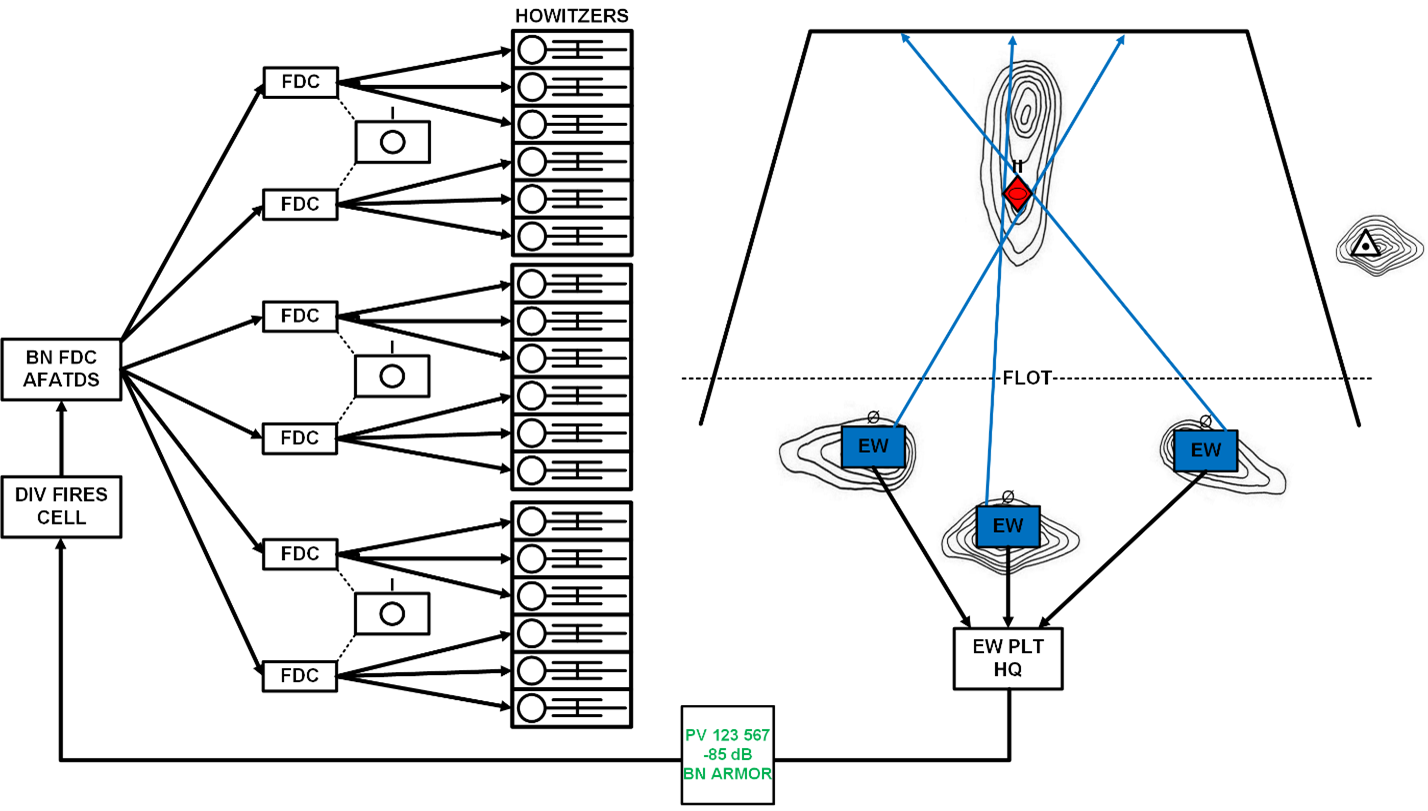
Flexibility and survivability matter more than rigid structure in irregular warfare. EW teams must capably operate alongside indigenous forces, jamming enemy drones during partner-led assaults. Yet too often, EW remains limited to force protection—like in Syria, where U.S. forces were focused on shielding communications from Russian jamming rather than contesting the spectrum offensively. To move beyond this focus, EW teams must enable maneuver by sending grid coordinates of suspected enemy presence directly to precision weapons such as long-range howitzers. Meanwhile, forward observers nearby can walk fires on until “steel-on-steel” effects are achieved.
Unlike the original CEWI concept, modern SIGINT should play a more strategic role at higher echelons, shaping broader operational and targeting decisions rather than being directly tethered to frontline EW teams. While SIGINT remains vital for informing EW targeting (by identifying and characterizing adversary signals that reveal force locations, intentions, or vulnerabilities) it often functions on longer timelines, particularly when routed through national-level agencies. These delays, which can stretch for hours or even days, limit its usefulness for responsive targeting in dynamic conflict environments. To stay effective under such conditions, EW must evolve into a faster, decentralized model, one that accelerates the kill chain and delivers effects at the pace of maneuver.
Critically, EW teams must be able to operate forward—not from far-removed tactical operations centers but embedded with their supported units. These dismounted teams, equipped with Terrestrial Layer System manpacks, can sense and disrupt enemy signals while on the go. Maneuver formations including special operations, reconnaissance, and light infantry provide the physical security and context needed to make EW survivable and effective.
Realistic, iterative training is also crucial. Signal-heavy infantry soldiers attempt to evade EW hunters in exercises like the 10th Mountain Division’s “Hunter-Electromagnetic Spectrum,” offering scalable and repeatable models to build proficiency under realistic conditions. Cyber-electromagnetic activities cells should still lead and enforce commonality in division-level certification standards. And more simulated D3SOE training given at combat training center rotations allows EW platoons to expeditiously conduct the three key EW functions.
The Path Forward
The future of irregular warfare will be fought and won in the electromagnetic spectrum. Whether intercepting hostile drones, locating rogue transmitters, or shielding resistance networks from detection, EW is no longer optional: it is a tactical necessity. A flexible EW structure, closely integrated with fires and maneuver, will prove decisive in modern conflict. Rebooting the Army’s CEWI concept means giving EW teams the autonomy and tools to operate independently at the tactical edge. Ultimately, failure to act risks strategic surprise. Adversaries are already using spectrum operations to blind, confuse, and disrupt U.S. forces in irregular settings—often before a single shot is fired. In the next fight, whomever controls the spectrum will dictate the tempo. CEWI 2.0 offers a path to counter this threat by ensuring the three essential functions of EW—attack, protection, and support—are fully integrated into tactical operations, not sidelined as niche or force protection tools. By embedding agile EW teams with maneuver and partner forces, enabling persistent SIGINT at higher echelons, and preparing units to operate in D3SOEs, CEWI 2.0 builds a structure capable of outpacing adversaries in both irregular and conventional conflict. But waiting for tomorrow will be too late – winning the spectrum fight in future irregular conflicts must start with building and fielding CEWI 2.0 today.
Conner Bender, Ph.D. is an artillery officer and EW platoon leader in the U.S. Army. He is also a nonresident fellow at the Modern War Institute.
The views expressed are those of the author(s) and do not reflect the official position of the Irregular Warfare Initiative, Princeton University’s Empirical Studies of Conflict Project, the Modern War Institute at West Point, or the United States Government.
Main image: EW specialist from 10th Mountain Division calibrates equipment during Hunter-EMS exercise (U.S. Army Photo by Spc. Kade Bowers)
If you value reading the Irregular Warfare Initiative, please consider supporting our work. And for the best gear, check out the IWI store for mugs, coasters, apparel, and other items.